This won´t be a long post, but I just have to write something about today´s fantastic trip.
I chose an early start tour to be sure that I would have maximum time amongst the wildlife. There are several possible routes, but most of them start with a dash from Puerto Madryn to Puerto Piramides for the whale watching.
You don´t actually need a boat. You can see the whales quite well from the shore. Even in Puerto Madryn you can see them cruising up and down off the beach, just a few hundred metres from the shore. At first glance they look like rocks awash, but rocks seldom move across the bay. There is no question, though, that admiring them is so much better from a boat.
Southern right whales congregate in the area to give birth to their 4,000 kg calves and to get the next generation started. They were called right whales by the early whalers because they were the right whale to hunt. They swim slowly and they float when they are dead, making them easy to catch.
Before we got near the whales the boat rules were explained. If the whale is to the right, all the people on the right stay seated and those to the left may stand. And vice versa. Seemed simple and sensible enough.
Only one tourist boat per whale is the limit, so we had to go out a ways to find an unattended whale. In fact it was a mother and her 2-month old calf. Everyone in the boat immediately stood up to get a better view. At least I was on the side permitted to do so. Mostly the whales just dipped below the surface, letting out noisy exhalations from time to time. But the mother did dive now and then, giving the classic tail wave as she did so.
The small, modest-priced digital camera I have with me is usually OK, but it´s not very prompt to reply to the shutter button. I now have lots of snaps of whales just disappearing below the surface.
After one dive the mother surfaced well away from our boat and we were treated to two ´jumps´. Fantastic.
Finally our skipper gave them a rest and moved over to another awash rock. This turned out to be three whales, one of which seemed to be a calf. One of these animals seemed to stand on its head. Certainly it waved its tail in the air many times for us. And another rolled on its side and cruised around playfully slapping the surface of the sea. I think that we witnessed just about the full set of surface behaviours, and all in brilliant sunshine with hardly any wind and a calm sea. Perfect.
Along the road we saw guanacos, the one member of the llama family that lives away from the mountains, and rheas (tick), which look very similar to their Australian relative, the emu. There were also lots of maras. These are a large rodent that burrows in the dry soil.
The next stop was to admire a colony of elephant seals. To simulate the excitement of an elephant seal family get some water ballooons: 10 or a dozen huge size in black or grey to represent pups, 12 to 14 enormous ones in brown and grey for the females and one humungous brown balloon for the bull. Two-thirds fill them with water. Place the humungous balloon on the beach any which way near the water. Place the others in a bunch all oriented up and down the beach. It doesn´t matter whether it is head or tail towards the water. Sit and watch.
I exaggerate of course, but there was not much action. The males displayed evidence of recent battles and an occasional flipper scooped some beach gravel over the sunbather´s body. Three were actually in the water. A couple of the pups bleated loudly. Their fond mothers were either at sea or too deeply asleep to respond.
There were birds around, including giant petrels (tick), a kind of chocolate-coloured albatross. But the most striking bird was in the scrub at the top of the cliff. The cock long-tailed meadowlark has red all down his chin and front and bold white stripes on his head. The scarlet marking is irregular, as though he´s been hit with cartoon tomatoes. HUGE TICK. The female was much less gaudy.
A little way North there is a small colony of magellanic penguins. You can get so close you could almost pat them. But I won´t get too excited about them because tomorrow I am off to Punta Tombo where there is a colony of 400,000 penguins.
15 October 2007

12 October 2007
Bariloche
The chonologically last instalment, Greetings from Uruguay, had me in Carmelo waiting for the Saturday evening ferry.
The bars were showing soccer. Uruguay was not involved in the rugby world cup, so why would their television devote time to it? I found an Internet cafe that was open and followed the score on the official web site. O woe for NZ.
So it was with shock and a heavy heart that I queued to board the Delta Cat II. This is a modern vessel, but not as rocket propelled as the Buquebus that I left Buenos Aires on. The sun was low, but still in the sky, so we had daylight for the start of the crossing.
The wharf is a few hundred metres up a tributary of the main river, so we started gliding down between tree-lined banks. There was actually nearly half an hour before sunset, motoring between low islands. Some had only grasses and rushes, others had trees. A vast improvement on the featureless water all the way to Colonia del Sacramento. There was enough light to see by for about another 30 minutes and then it got very dark.
There were very few navigation lights that I could see, but the skipper had radar, a chart plotter and plenty of experience so we didn´t hit anything and fetched up in Tigre on time.
This was the third time I had entered Argentina and the first time I had been asked to fill in a customs declaration. I confessed that I was carrying bee products (honey), but the customs officer shooed me through. He didn´t want his evening spoiled by people carrying illegal honey. The same honey had been in my pack on the previous two border crossings, but no-one asked about it.
An information desk in the port building directed me to a nearby B&B, but it was full. The port area had lights and grass and a McDonalds so it was perfectly safe to scout around, but the tourist information office was closed. That´s pretty reasonable for 9:30 on a Saturday night. I reasoned that the train station might have cheap hotels nearby or an information desk so I toddled over there. No hotels and no info desk, but I asked at a snack stall.
The lady on my side of the counter conferred with the serving lass and they agreed on a place but, they said, it was quite far and dangerous to walk. The lady came with me to the taxi stand to make sure the driver knew where to take me. Wasn´t that kind?
The streets didn´t look dangerous to me, but it was a drive of several minutes with many turns. Walking would have meant almost certainly losing the way. I was dropped at a large residencial but, alas, they had no rooms either. There were no rooms in anywhere in Tigre that night I was told. It was now after 10pm. Even if there was another train, it would deposit me in central BA after 11 o´clock. Not a welcome prospect.
The couple running the residencial did know of an expensive hotel in another suburb. What was the alternative - sleeping in the park? They generously telephoned and booked me in and then telephoned for a taxi. It was a long ride and the hotel was not easy to find. Journey´s end was getting on for 11pm.
Hotel del Casco is a boutique hotel and very expensive. However, it had a room free and I graciously accepted the neccesity of luxury. The ensuite bathroom had both a bath and a shower. There was a chocolate on the turned down sheet. I had a long shower and used lots of the shampoo and conditioner. The TV had at least 5 sports channels, but they were all in earnest after-match discussion mode, except one that was broadcasting baseball. I don´t know the game well enough to enjoy watching it, so I stretched out in my king-size bed and fell asleep.
Next morning I was either the first guest up, or the last. Anyway, I had the breakfast room to myself. I made the most of a first-class breakfast buffet and the best coffee I´ve had in South America. I selected some fruit for later consumption and souvenired the partly used soap and shampoo.
When I checked out it was the first time I had used my credit card for anything but a cash withdrawal since Lima in June. The scarcity of hotel beds in greater Buenos Aires was due to a convention of dermatologists, the clerk explained.
I don´t think many of its monied guests leave Hotel del Casco carrying a pack and walking to the train station. But the rest of the day was plain sailing. The train took me to Retiro station, which is next door to the long-distance bus terminal. I found a convenient overnight bus to Bariloche and bought a ticket. I watched the last 20 minutes of S. Africa vs Fiji in one of the cafeterias and had a satisfying lunch.
There was a moment of confusion when I tried to board the 14:00 hours bus, instead of the 14:05. Well, only the 14:05 was showing on the electronic departure board. But that was quickly resolved and we set off in a bus so modern the upholstery still had a whiff of that ´new vehicle´ smell.
The Via Bariloche cama service has restored the reputation of Argentinian buses. It was very comfortable. There was coffee and a sandwich for afternoon tea and a hot meal with wine for dinner. There was even champagne, but it was served so late I was too tired to want any.
We cruised smoothly over the province of Buenos Aires. I have come across so much flat land in South America. From the top deck of the bus I could see to the horizon in every direction and it was FLAT. There were fences and trees and cows and buildings all on flat, flat land. I even imagined I could see the curvature of the earth. This continued until the daylight failed 6 hours into the journey. As far as I could see it was still flat when I woke to visit the loo in the night.
In the morning we were gently but firmly awakened. And there were scrub-covered hills outside instead of grassy plains. Were we on a different planet? To our left, so I could not see it well, was a slow-moving river. Either that or an immensly long lake. Coffee and breakfast helped to get the brain working properly.
The timing of the wake-up call was just right. By the time breakfast had been served and the empty trays gathered in, there was just enough time to pack up and put my contact lenses in before we drew up in Bariloche bus terminal a quarter of an hour early.
San Carlos de Bariloche is soooo like Queenstown. All that´s missing is jet boating. It is on a lake with tree-clad mountains at the back, a large ski-field nearby and all facilities for tourists, including over-priced restaurants. Many Swiss have settled in the area and it has the additional attraction of chocolate-making. Many shops in the town sell nothing else. One of the more prominent chocolaterias is called Rapa Nui. Why is it named after Easter Island? A Spanish-speaking Austrian at the hostel went in and asked. "No reason."
I stayed at Hostel 1004. The unusual name has a very good reason. It is on the 10th and top floor of an apartment building near the lake in Bariloche. It is apartment 1004. Simple. The views over the lake from the common room are stupendous.
Having got my bearings I set out to enjoy the mountain scenery. A local bus took me along to withing easy walking distance of a national park. I followed a trail through the woods where the heard-but-unseen bird was abundant. Amongst a school party coming the other way I spotted a youth with iPod earphones in each ear. I fear the birdsong was wasted on him.
In the afternoon I took a boat ride on the lake to visit Isla Victoria. The significance of this island was lost on me because I could not understand more than 5% of the commentary. On the Altiplano I usually understood 50% or more of what the Spanish-speaking guides said. Anyway I had an hour to roam this island before we re-embarked and carried on to a special area that is a park in its own right within a national park.
The tree that makes this area so special is the arrayan.
It has lovely cinnamon coloured bark and there is one peninusla where it particularly flourishes. We were only allowed 45 minutes there, but that was ample to go round the walkway and take many photos of the beautiful trees.
That evening the hostel organised a "wine tasting". Everyone bought a bottle of wine, they were all carefully opened and set out on a big table, and then the music was turned up and it was party time! No-one made any tasting notes. I can´t explain why, but the ambience of Hostel 1004 generates a special atmosphere. Conversation flows particularly freely. It is one of the sleeping places I can most heartily recommend.
On Wednesday we all got up a bit late for some reason. Patrick, the Spanish-speaking Austrian, planned to trek around all of Bariloche´s chocolate shops. I opted for a more prosaic walk up Cerro Otto. The tramp was harder than I expected. The last kilometre was through and around patches of snow. This would not have been such an issue if I had remebered to change into my tramping boots, but I set off in sneakers. Silly Bill. However, the views were glorious.
Back in town I elected to cook myself a steak meal in the hostel´s excellent kitchen. The supermarket offered, amongst other labels, wines of the "Aberdeen Angus" brand. I am not making this up. There is a photo of the label in the camera. It was not a premium product, so I selected a bottle of the syrah for about $4. It wasn´t as good as the meat was, but it was better than some of the wines tasted the previous evening.
Today I have moved down the road to El Bolson. It´s a very laid back town and I like it. The craft market today has some interesting stuff, but there`s no room in my pack. However, it provided some interesting snacks for lunch and some very good locally brewed beer.
Oh dear. This reads like I´m becoming an alcoholic. I promise it´s not true, dear readers.
Please leave comments or send emails. It´s good to get feedback.
The bars were showing soccer. Uruguay was not involved in the rugby world cup, so why would their television devote time to it? I found an Internet cafe that was open and followed the score on the official web site. O woe for NZ.
So it was with shock and a heavy heart that I queued to board the Delta Cat II. This is a modern vessel, but not as rocket propelled as the Buquebus that I left Buenos Aires on. The sun was low, but still in the sky, so we had daylight for the start of the crossing.
The wharf is a few hundred metres up a tributary of the main river, so we started gliding down between tree-lined banks. There was actually nearly half an hour before sunset, motoring between low islands. Some had only grasses and rushes, others had trees. A vast improvement on the featureless water all the way to Colonia del Sacramento. There was enough light to see by for about another 30 minutes and then it got very dark.
There were very few navigation lights that I could see, but the skipper had radar, a chart plotter and plenty of experience so we didn´t hit anything and fetched up in Tigre on time.
This was the third time I had entered Argentina and the first time I had been asked to fill in a customs declaration. I confessed that I was carrying bee products (honey), but the customs officer shooed me through. He didn´t want his evening spoiled by people carrying illegal honey. The same honey had been in my pack on the previous two border crossings, but no-one asked about it.
An information desk in the port building directed me to a nearby B&B, but it was full. The port area had lights and grass and a McDonalds so it was perfectly safe to scout around, but the tourist information office was closed. That´s pretty reasonable for 9:30 on a Saturday night. I reasoned that the train station might have cheap hotels nearby or an information desk so I toddled over there. No hotels and no info desk, but I asked at a snack stall.
The lady on my side of the counter conferred with the serving lass and they agreed on a place but, they said, it was quite far and dangerous to walk. The lady came with me to the taxi stand to make sure the driver knew where to take me. Wasn´t that kind?
The streets didn´t look dangerous to me, but it was a drive of several minutes with many turns. Walking would have meant almost certainly losing the way. I was dropped at a large residencial but, alas, they had no rooms either. There were no rooms in anywhere in Tigre that night I was told. It was now after 10pm. Even if there was another train, it would deposit me in central BA after 11 o´clock. Not a welcome prospect.
The couple running the residencial did know of an expensive hotel in another suburb. What was the alternative - sleeping in the park? They generously telephoned and booked me in and then telephoned for a taxi. It was a long ride and the hotel was not easy to find. Journey´s end was getting on for 11pm.
Hotel del Casco is a boutique hotel and very expensive. However, it had a room free and I graciously accepted the neccesity of luxury. The ensuite bathroom had both a bath and a shower. There was a chocolate on the turned down sheet. I had a long shower and used lots of the shampoo and conditioner. The TV had at least 5 sports channels, but they were all in earnest after-match discussion mode, except one that was broadcasting baseball. I don´t know the game well enough to enjoy watching it, so I stretched out in my king-size bed and fell asleep.
Next morning I was either the first guest up, or the last. Anyway, I had the breakfast room to myself. I made the most of a first-class breakfast buffet and the best coffee I´ve had in South America. I selected some fruit for later consumption and souvenired the partly used soap and shampoo.
When I checked out it was the first time I had used my credit card for anything but a cash withdrawal since Lima in June. The scarcity of hotel beds in greater Buenos Aires was due to a convention of dermatologists, the clerk explained.
I don´t think many of its monied guests leave Hotel del Casco carrying a pack and walking to the train station. But the rest of the day was plain sailing. The train took me to Retiro station, which is next door to the long-distance bus terminal. I found a convenient overnight bus to Bariloche and bought a ticket. I watched the last 20 minutes of S. Africa vs Fiji in one of the cafeterias and had a satisfying lunch.
There was a moment of confusion when I tried to board the 14:00 hours bus, instead of the 14:05. Well, only the 14:05 was showing on the electronic departure board. But that was quickly resolved and we set off in a bus so modern the upholstery still had a whiff of that ´new vehicle´ smell.
The Via Bariloche cama service has restored the reputation of Argentinian buses. It was very comfortable. There was coffee and a sandwich for afternoon tea and a hot meal with wine for dinner. There was even champagne, but it was served so late I was too tired to want any.
We cruised smoothly over the province of Buenos Aires. I have come across so much flat land in South America. From the top deck of the bus I could see to the horizon in every direction and it was FLAT. There were fences and trees and cows and buildings all on flat, flat land. I even imagined I could see the curvature of the earth. This continued until the daylight failed 6 hours into the journey. As far as I could see it was still flat when I woke to visit the loo in the night.
In the morning we were gently but firmly awakened. And there were scrub-covered hills outside instead of grassy plains. Were we on a different planet? To our left, so I could not see it well, was a slow-moving river. Either that or an immensly long lake. Coffee and breakfast helped to get the brain working properly.
The timing of the wake-up call was just right. By the time breakfast had been served and the empty trays gathered in, there was just enough time to pack up and put my contact lenses in before we drew up in Bariloche bus terminal a quarter of an hour early.
San Carlos de Bariloche is soooo like Queenstown. All that´s missing is jet boating. It is on a lake with tree-clad mountains at the back, a large ski-field nearby and all facilities for tourists, including over-priced restaurants. Many Swiss have settled in the area and it has the additional attraction of chocolate-making. Many shops in the town sell nothing else. One of the more prominent chocolaterias is called Rapa Nui. Why is it named after Easter Island? A Spanish-speaking Austrian at the hostel went in and asked. "No reason."
I stayed at Hostel 1004. The unusual name has a very good reason. It is on the 10th and top floor of an apartment building near the lake in Bariloche. It is apartment 1004. Simple. The views over the lake from the common room are stupendous.
Having got my bearings I set out to enjoy the mountain scenery. A local bus took me along to withing easy walking distance of a national park. I followed a trail through the woods where the heard-but-unseen bird was abundant. Amongst a school party coming the other way I spotted a youth with iPod earphones in each ear. I fear the birdsong was wasted on him.
In the afternoon I took a boat ride on the lake to visit Isla Victoria. The significance of this island was lost on me because I could not understand more than 5% of the commentary. On the Altiplano I usually understood 50% or more of what the Spanish-speaking guides said. Anyway I had an hour to roam this island before we re-embarked and carried on to a special area that is a park in its own right within a national park.
The tree that makes this area so special is the arrayan.
It has lovely cinnamon coloured bark and there is one peninusla where it particularly flourishes. We were only allowed 45 minutes there, but that was ample to go round the walkway and take many photos of the beautiful trees.
That evening the hostel organised a "wine tasting". Everyone bought a bottle of wine, they were all carefully opened and set out on a big table, and then the music was turned up and it was party time! No-one made any tasting notes. I can´t explain why, but the ambience of Hostel 1004 generates a special atmosphere. Conversation flows particularly freely. It is one of the sleeping places I can most heartily recommend.
On Wednesday we all got up a bit late for some reason. Patrick, the Spanish-speaking Austrian, planned to trek around all of Bariloche´s chocolate shops. I opted for a more prosaic walk up Cerro Otto. The tramp was harder than I expected. The last kilometre was through and around patches of snow. This would not have been such an issue if I had remebered to change into my tramping boots, but I set off in sneakers. Silly Bill. However, the views were glorious.
Back in town I elected to cook myself a steak meal in the hostel´s excellent kitchen. The supermarket offered, amongst other labels, wines of the "Aberdeen Angus" brand. I am not making this up. There is a photo of the label in the camera. It was not a premium product, so I selected a bottle of the syrah for about $4. It wasn´t as good as the meat was, but it was better than some of the wines tasted the previous evening.
Today I have moved down the road to El Bolson. It´s a very laid back town and I like it. The craft market today has some interesting stuff, but there`s no room in my pack. However, it provided some interesting snacks for lunch and some very good locally brewed beer.
Oh dear. This reads like I´m becoming an alcoholic. I promise it´s not true, dear readers.
Please leave comments or send emails. It´s good to get feedback.
07 October 2007
Buenos Aires
This is a bit back to front, because I was in Buenos Aires before Uruguay, but that´s how the mood took me. This post was going to be an account of the scenery around Tupiza in Bolivia, but the computer here is just too slow on the photo CD. Maybe I´ll move to another Internet cafe later.
As previously mentioned, I arrived in BA in glorious sunshine with the Hampshire Harlequins. I left them to the perils of their 4-star hotel and hied me to a centrally located hostel.
It was a Sunday, so my first sortie found useful things like supermarkets closed, while the pedestrian mall of Avenida Florida had boutiques and souvenir parlours open for business. Not everyone took that view. I met some Grammar Lions (Golden Oldies hockey players from Auckland) who were excited at the prices of leather jackets. Their enthusiam was rather wasted on me, because I have no desire for leather clothing.
The intersecting Avenida Lavalle is also pedestrians only for several blocks, and here I located plenty of eating houses. I would not starve. A number of these have employees standing in the street handing advertising to passers by.
This wasn´t too bad, but lurking in the shadows were other distributors of literature, trying to lure the visitor into bars and clubs. When I relate that the first one I accepted carried a picture of a woman with nothing on you will understand which industry these pests were in. Thereafter I declined all handouts.
Monday dawned wet, so I limited myself to the central sights near the hostel. In the cathedral there are not only side chapels with attendant saints, but the last resting place of General San Martin, liberator of Argentina from Spanish rule. From the information around his tomb you would get the impression that he also freed Bolivia, Peru and Ecuador. But in Peru and Bolivia all the credit is given to Simon Bolivar. Where do I get an unbiased history of South America?
It was at San Martin´s grave that I encountered more Golden Oldies, this time from the Dutch Over-65s team. However, we respected the signs requesting silence. We contented ourselves with smiling our recognition and shaking hands.
Outside the showers persisted. I took a couple of photos of the Casa Rosada (the US president lives in a White House, the Argentine one in a Pink House) before following a sign to an ethnographic museum. This turned out to be a department of the university and mainly, if I understood the signs correctly, a research facility. The signs were clear that it was not open to the public on Mondays.
However the route took me past the Iglesia de San Francisco, which was open. Unusually, it had no gold leaf or other bling around the alter. Instead there was a large wall hanging, a tapestry I think. Since photography was not forbidden I tried to hold the camera steady enough for the long exposure necessary in the gloom.
Tuesday was better weather so I elected to follow the Lonely Planet walking tour. To get to the starting point I took the Subte, BA´s underground railway. I did not make the most efficient journey as there are two stations named Callao, which strikes me as an unusual way to arrange a rapid transit system. I later found there are two named Independencia as well.
The walk starts at the Recoleta Cemetry. I thought this rather odd until I got there. It is a necropolis, where the residents are interred beneath or inside little houses, or palaces if you are rich enough. I had seen a couple of these from buses in Paraguay but this was the first time I had ever seen one up close.
I was pounced on by a lady as I arrived. She sold me a map of the cemetery, with a recommended route and the most interesting memorials marked on it. This was very useful. I must have spent two hours or so meandering round the "streets". Some of the little buildings are quite sumptuous and others are falling into ruin. Presumably the latter belong to families who have died out or fallen on hard times.
Evita´s tomb gets a lot of visitors. She is in the Duarte family tomb, while her husband, the former president Juan Peron is in a another, less prestigious, cemetery. However, many of Argentina´s ex-presidents are amongst the Recoleta residents, together with military leaders, writers, scholars (not many of them that I could see) and artists. The biggest tomb belonged to a banker.
Back amongst the living, the walking tour took me past the Engineering School in an odd, but doubtless perfectly sound, building to a huge artwork. A gigantic silver flower, possibly meant to be a lotus, stands in a large artificial pond. At night the petals close, although the postcards I bought suggest that they do not close very tightly.
Apart from a wander round a pretty church, there was not much of note in the rest of the tour. The BA Design Centre is not my thing and the Law School building was not nearly so interesting as the Engineering School.
In the afternoon I had my final encounter with another Golden Oldie. It was Rose from the Hampshire Harlequins enjoying a little free time between a hectic schedule of post-hockey tours.
Wednesday was an altogether different day. No more churches or big buildings, I set off for an ecological reserve. I intended to pop in to the South American Explorers clubhouse, but when I got there it was not due to open until 1pm. Too bad.
The reserve is accessed from a fairly busy street. It´s about 100m to the gates. The layout is very roughly a figure of eight sytem of walking tracks around a couple of lakes. I did not make notes from the helpful signs, but I think the circumference is between 4 and 5 km. It took me hours, and I didn´t go all the way round.
Although it is only 100m from a major city, the birdlife is astonishing. I will not bore you with a full list, but I added 20 ticks and met plenty of old friends, too. There was also one bird I saw twice, both times very clearly, but could not locate in the field guide.
At one point early on a local birder opened a conversation. His English was a little better than my Spanish, but bird talk does not feature in the phrase book. He particularly pointed out where to look for a bird called sietecolores (seven colours).
Amongst the information boards was one that illustrated some particularly colourful birds. They included my megatick vermillion flycatcher and the sietecolores, which I could look up and translate as the many-coloured reed tyrant. I did catch a couple of glimpses of scarlet, but the only one of the colourful birds that I actually identified was the masked gnatcatcher, which sports nice blue wings.
The city was hosting a convention of dermatologists, 15,000 of them according to a delegate I spoke to. He was a Brazilian medical student called Guilherme. He and several other students were staying at the same hostel. Guilherme does not plan to specialise as a dermatologist himself, but the student registration was very cheap and his tutor recommended that he go.
Apart from speaking very good English, polished in part by staying with relatives in Manchester, Guilherme plays the guitar. One evening there was a very enjoyable singalong in the hostel, although most of the songs were in Portuguese and known only to the Brazilian students. He did throw in a couple of Beatles numbers and we discovered that I don´t know all the words these days.
We have swapped email addresses to swap news and hopefully maintain contact until either Guilherme visits NZ or I get to see Brazil.
The dormitory had bunks three-high so there wasn´t a lot of space. I made the mistake of packing while sitting crouched on my bottom bunk. This didn´t do my back a lot of good, so I set off for the fast ferry to Uruguay in some pain. However, the anti-inflammatories calmed things down and I am fine now. Which brings us up to the point where the Uruguay post started.
As previously mentioned, I arrived in BA in glorious sunshine with the Hampshire Harlequins. I left them to the perils of their 4-star hotel and hied me to a centrally located hostel.
It was a Sunday, so my first sortie found useful things like supermarkets closed, while the pedestrian mall of Avenida Florida had boutiques and souvenir parlours open for business. Not everyone took that view. I met some Grammar Lions (Golden Oldies hockey players from Auckland) who were excited at the prices of leather jackets. Their enthusiam was rather wasted on me, because I have no desire for leather clothing.
The intersecting Avenida Lavalle is also pedestrians only for several blocks, and here I located plenty of eating houses. I would not starve. A number of these have employees standing in the street handing advertising to passers by.
This wasn´t too bad, but lurking in the shadows were other distributors of literature, trying to lure the visitor into bars and clubs. When I relate that the first one I accepted carried a picture of a woman with nothing on you will understand which industry these pests were in. Thereafter I declined all handouts.
Monday dawned wet, so I limited myself to the central sights near the hostel. In the cathedral there are not only side chapels with attendant saints, but the last resting place of General San Martin, liberator of Argentina from Spanish rule. From the information around his tomb you would get the impression that he also freed Bolivia, Peru and Ecuador. But in Peru and Bolivia all the credit is given to Simon Bolivar. Where do I get an unbiased history of South America?
It was at San Martin´s grave that I encountered more Golden Oldies, this time from the Dutch Over-65s team. However, we respected the signs requesting silence. We contented ourselves with smiling our recognition and shaking hands.
Outside the showers persisted. I took a couple of photos of the Casa Rosada (the US president lives in a White House, the Argentine one in a Pink House) before following a sign to an ethnographic museum. This turned out to be a department of the university and mainly, if I understood the signs correctly, a research facility. The signs were clear that it was not open to the public on Mondays.
However the route took me past the Iglesia de San Francisco, which was open. Unusually, it had no gold leaf or other bling around the alter. Instead there was a large wall hanging, a tapestry I think. Since photography was not forbidden I tried to hold the camera steady enough for the long exposure necessary in the gloom.
Tuesday was better weather so I elected to follow the Lonely Planet walking tour. To get to the starting point I took the Subte, BA´s underground railway. I did not make the most efficient journey as there are two stations named Callao, which strikes me as an unusual way to arrange a rapid transit system. I later found there are two named Independencia as well.
The walk starts at the Recoleta Cemetry. I thought this rather odd until I got there. It is a necropolis, where the residents are interred beneath or inside little houses, or palaces if you are rich enough. I had seen a couple of these from buses in Paraguay but this was the first time I had ever seen one up close.
I was pounced on by a lady as I arrived. She sold me a map of the cemetery, with a recommended route and the most interesting memorials marked on it. This was very useful. I must have spent two hours or so meandering round the "streets". Some of the little buildings are quite sumptuous and others are falling into ruin. Presumably the latter belong to families who have died out or fallen on hard times.
Evita´s tomb gets a lot of visitors. She is in the Duarte family tomb, while her husband, the former president Juan Peron is in a another, less prestigious, cemetery. However, many of Argentina´s ex-presidents are amongst the Recoleta residents, together with military leaders, writers, scholars (not many of them that I could see) and artists. The biggest tomb belonged to a banker.
Back amongst the living, the walking tour took me past the Engineering School in an odd, but doubtless perfectly sound, building to a huge artwork. A gigantic silver flower, possibly meant to be a lotus, stands in a large artificial pond. At night the petals close, although the postcards I bought suggest that they do not close very tightly.
Apart from a wander round a pretty church, there was not much of note in the rest of the tour. The BA Design Centre is not my thing and the Law School building was not nearly so interesting as the Engineering School.
In the afternoon I had my final encounter with another Golden Oldie. It was Rose from the Hampshire Harlequins enjoying a little free time between a hectic schedule of post-hockey tours.
Wednesday was an altogether different day. No more churches or big buildings, I set off for an ecological reserve. I intended to pop in to the South American Explorers clubhouse, but when I got there it was not due to open until 1pm. Too bad.
The reserve is accessed from a fairly busy street. It´s about 100m to the gates. The layout is very roughly a figure of eight sytem of walking tracks around a couple of lakes. I did not make notes from the helpful signs, but I think the circumference is between 4 and 5 km. It took me hours, and I didn´t go all the way round.
Although it is only 100m from a major city, the birdlife is astonishing. I will not bore you with a full list, but I added 20 ticks and met plenty of old friends, too. There was also one bird I saw twice, both times very clearly, but could not locate in the field guide.
At one point early on a local birder opened a conversation. His English was a little better than my Spanish, but bird talk does not feature in the phrase book. He particularly pointed out where to look for a bird called sietecolores (seven colours).
Amongst the information boards was one that illustrated some particularly colourful birds. They included my megatick vermillion flycatcher and the sietecolores, which I could look up and translate as the many-coloured reed tyrant. I did catch a couple of glimpses of scarlet, but the only one of the colourful birds that I actually identified was the masked gnatcatcher, which sports nice blue wings.
The city was hosting a convention of dermatologists, 15,000 of them according to a delegate I spoke to. He was a Brazilian medical student called Guilherme. He and several other students were staying at the same hostel. Guilherme does not plan to specialise as a dermatologist himself, but the student registration was very cheap and his tutor recommended that he go.
Apart from speaking very good English, polished in part by staying with relatives in Manchester, Guilherme plays the guitar. One evening there was a very enjoyable singalong in the hostel, although most of the songs were in Portuguese and known only to the Brazilian students. He did throw in a couple of Beatles numbers and we discovered that I don´t know all the words these days.
We have swapped email addresses to swap news and hopefully maintain contact until either Guilherme visits NZ or I get to see Brazil.
The dormitory had bunks three-high so there wasn´t a lot of space. I made the mistake of packing while sitting crouched on my bottom bunk. This didn´t do my back a lot of good, so I set off for the fast ferry to Uruguay in some pain. However, the anti-inflammatories calmed things down and I am fine now. Which brings us up to the point where the Uruguay post started.
Hello from Uruguay
I admit that part of the reason for coming to Uruguay was to get another country´s stamp in my passport. I can add a new name to the list of countries visited. It´s quite a small country squished in between Argentina and Brazil on South America´s Atlantic coast. The population, I´ve been told, is 3 million and it doesn´t have any must-see attractions like Machu Picchu or Iguacu.
I did toy with the idea of visiting the capital, Montevideo, where the Graf Spee took refuge after the battle of the River Plate in WW2, but Buenos Aires was quite enough big city for a while so I settled for sightseeing in Colonia del Sacramento and a boat trip through the delta back to Argentina.
Getting to Colonia is easy. Buquebus runs several fast ferries daily from BA across the river direct to Colonia. It´s a popular destination for Porteños (citizens of Buenos Aires) particularly in the summer. The journey is only one hour each way so it can be a day trip. I chose the 2pm sailing, which doesn´t take cars and is therefore probably less prone to complications.
The journey itself was rather dull. The River Plate is prone to fogs, and a light mist restricted visibility. There are no decks for the passengers to take the air. All I could see thrugh the window was the water rushing past at 30 knots. Accoding to Buquebus literature the vessel´s top speed is 50 knots. I get excited if my little yacht goes over 6 knots.
The hostel I had selected from the guide book had plenty of room. In fact I had a dormitory to myself.
There was enough daylight left for a wander. Down by the river a group of schoolchildren were flying kites. The lack of wind made this much more difficult, but it didn´t appear to dampen their enthusiasm. I hope they had insect repellent with them, because some biting things found me. Luckily their range did not extend to the town.
After the noise and bustle of BA, Colonia is delightfully peaceful. Most of the streets are lined by trees and the old streets are "cobbled", although the paving is so irregular that they are a danger to anything less than a Land Rover.
There are many restaurants in the old town, but they are distinctly upmarket. Only a couple of them advertised specials. The one I chose was having a particularly slow evening. I was the only customer. The waitress assured me that they had the opposite problem in the summer season.
In the morning I followed the guide book description of the old, colonial period town. This included the local museums. Each is quite small, but one inexpensive ticket admits you to all of them. And it was a good day to be indoors. Dark, thick clouds hung threateningly overhead and the heavy showers started as I made my way to the bus terminal.
My destination was Carmelo, the departure point for the slower ferries that take the scenic route through the delta to Tigre in Argentina. The bus took me through undulating green fields with cows or soggy crops. It could have been almost anywhere in Northern Europe or NZ´s North Is.
I managed to get off at the right place and find the cheaper hotel listed in Lonely Planet. It had put its prices up, but cunningly not so much that it was worth looking elsewhere. In truth it was a bit of a dump, but the manager was cheerful and very helpful with directions. It was clean, had a private bathroom and it was only for one night.
Or was it? My first excursion was to the ferry company´s office. Alas for my dreams of a picturesque cruise through the islands of the delta. The Saturday sailings were before dawn, which was fully booked anyway, or after sunset. I could wait until Sunday when the sailing was just after midday, but that would arrive in Tigre too late to catch the Sunday bus to Bariloche. If I caught the Monday bus I would not arrive in Bariloche until Tuesday. Carmelo has no particular attractions to enhance an 18 hour delay.
After tossing all the options around I settled for the Saturday evening sailing and hope that the light will linger.
Dinner was grilled meat and salad with a half-litre jug of house wine. Most satisfying. And only two thirds the price of the tourist restaurant in Colonia. The TV news was full of the rain and its effects. It seems that this area got off lightly.
And now it is Saturday. The sun is shining, a little wanly to be sure, but there are shadows. Carmelo has just about shut down. This Internet cafe will close at 12:30 and reopen at 4:00. I did some shopping this morning so I have bread and cheese and fruit in my pack. But surely the cafes will be open at lunchtime?
In other posts, I have added a few words and several pictures to the Uyuni-Tupiza story and redated it 1 October. The Salar de Uyuni Part 2 is now complete with lots of photos.
Keep the comments and emails coming.
I did toy with the idea of visiting the capital, Montevideo, where the Graf Spee took refuge after the battle of the River Plate in WW2, but Buenos Aires was quite enough big city for a while so I settled for sightseeing in Colonia del Sacramento and a boat trip through the delta back to Argentina.
Getting to Colonia is easy. Buquebus runs several fast ferries daily from BA across the river direct to Colonia. It´s a popular destination for Porteños (citizens of Buenos Aires) particularly in the summer. The journey is only one hour each way so it can be a day trip. I chose the 2pm sailing, which doesn´t take cars and is therefore probably less prone to complications.
The journey itself was rather dull. The River Plate is prone to fogs, and a light mist restricted visibility. There are no decks for the passengers to take the air. All I could see thrugh the window was the water rushing past at 30 knots. Accoding to Buquebus literature the vessel´s top speed is 50 knots. I get excited if my little yacht goes over 6 knots.
The hostel I had selected from the guide book had plenty of room. In fact I had a dormitory to myself.
There was enough daylight left for a wander. Down by the river a group of schoolchildren were flying kites. The lack of wind made this much more difficult, but it didn´t appear to dampen their enthusiasm. I hope they had insect repellent with them, because some biting things found me. Luckily their range did not extend to the town.
After the noise and bustle of BA, Colonia is delightfully peaceful. Most of the streets are lined by trees and the old streets are "cobbled", although the paving is so irregular that they are a danger to anything less than a Land Rover.
There are many restaurants in the old town, but they are distinctly upmarket. Only a couple of them advertised specials. The one I chose was having a particularly slow evening. I was the only customer. The waitress assured me that they had the opposite problem in the summer season.
In the morning I followed the guide book description of the old, colonial period town. This included the local museums. Each is quite small, but one inexpensive ticket admits you to all of them. And it was a good day to be indoors. Dark, thick clouds hung threateningly overhead and the heavy showers started as I made my way to the bus terminal.
My destination was Carmelo, the departure point for the slower ferries that take the scenic route through the delta to Tigre in Argentina. The bus took me through undulating green fields with cows or soggy crops. It could have been almost anywhere in Northern Europe or NZ´s North Is.
I managed to get off at the right place and find the cheaper hotel listed in Lonely Planet. It had put its prices up, but cunningly not so much that it was worth looking elsewhere. In truth it was a bit of a dump, but the manager was cheerful and very helpful with directions. It was clean, had a private bathroom and it was only for one night.
Or was it? My first excursion was to the ferry company´s office. Alas for my dreams of a picturesque cruise through the islands of the delta. The Saturday sailings were before dawn, which was fully booked anyway, or after sunset. I could wait until Sunday when the sailing was just after midday, but that would arrive in Tigre too late to catch the Sunday bus to Bariloche. If I caught the Monday bus I would not arrive in Bariloche until Tuesday. Carmelo has no particular attractions to enhance an 18 hour delay.
After tossing all the options around I settled for the Saturday evening sailing and hope that the light will linger.
Dinner was grilled meat and salad with a half-litre jug of house wine. Most satisfying. And only two thirds the price of the tourist restaurant in Colonia. The TV news was full of the rain and its effects. It seems that this area got off lightly.
And now it is Saturday. The sun is shining, a little wanly to be sure, but there are shadows. Carmelo has just about shut down. This Internet cafe will close at 12:30 and reopen at 4:00. I did some shopping this morning so I have bread and cheese and fruit in my pack. But surely the cafes will be open at lunchtime?
In other posts, I have added a few words and several pictures to the Uyuni-Tupiza story and redated it 1 October. The Salar de Uyuni Part 2 is now complete with lots of photos.
Keep the comments and emails coming.
02 October 2007
Uyuni to Tupiza and Enduring Shame with PICS
Travelling from town to town in Bolivia is frequently uncomfortable, seldom on time and sometimes downright unpleasant, but it has not yet been a mundane gap in my life between experiences in one place and adventures in another.
For some reason all the road transport from Uyuni to Tupiza leaves before dawn. At least that´s better than the train, which operates entirely at night and only runs twice a week.
The options were a bus or jeep. I decided on a bus for comfort, and because they leave an hour later. However, the company I chose with a 6am departure then informed me that I should report at 5:30. Ugh.
So I grumbled my way through the cold night to the 11 de Junio office (several bus companies have chosen dates for their names - very odd) just before 5:30. Promptly at 5:50 the vehicle appeared and started loading. But it was a jeep! Well, it was a Toyota Land Cruiser modified for extra passengers. Two lucky souls sat up front and the other 10 of us plus a toddler-on-Mum´s-lap sat in two rows of 5 with just enough room for our knees in the middle. The locals had all brought thick blankets, but we were so tightly packed that they cannot have made much difference to the warmth. However, they did restrict even further the opportunities to rearrange knees and feet.

For some reason all the road transport from Uyuni to Tupiza leaves before dawn. At least that´s better than the train, which operates entirely at night and only runs twice a week.
The options were a bus or jeep. I decided on a bus for comfort, and because they leave an hour later. However, the company I chose with a 6am departure then informed me that I should report at 5:30. Ugh.
So I grumbled my way through the cold night to the 11 de Junio office (several bus companies have chosen dates for their names - very odd) just before 5:30. Promptly at 5:50 the vehicle appeared and started loading. But it was a jeep! Well, it was a Toyota Land Cruiser modified for extra passengers. Two lucky souls sat up front and the other 10 of us plus a toddler-on-Mum´s-lap sat in two rows of 5 with just enough room for our knees in the middle. The locals had all brought thick blankets, but we were so tightly packed that they cannot have made much difference to the warmth. However, they did restrict even further the opportunities to rearrange knees and feet.

My "bus", photographed later unloading in Atocha.
I gazed enviously at the real bus outside the other company´s office. It had been there since before I arrived so luggage was stored and passengers seated for a prompt start at 6 o´clock.
We left late. Too bad. But before we had left Uyuni behind my bladder commenced complaining. Oh no. Luxurious buses with toilets are scarce in Bolivia, especially down here in the South. They are unknown on this route. I would never survive the whole journey. Could I save face and suppress nature until the stop in Atocha?
I had relieved myself last thing before I left the hotel. It must be nerves then. Think of something else, Bill. Well I watched the lights of Uyuni disappear; I concentrated on the sun coming up over the mountains far away across the salt desert; I studied the terrain and hoped for some wildlife to distract me, but all to no avail. The more I thought about it, the more urgent my need became. Can I at least hang on until 7 o´clock. An hour after the due time for leaving isn´t so disgraceful, is it? The jeep´s radio was on. I´ll be OK until the end of this song. Arrrrgh.
Eventually I bowed to the inevitable and confessed my need to the driver and my fellow passengers. Oh, disgrace to the whole race of gringos. The driver cheerfully pulled up and half the people in the rear section had to alight to let me out. However, I noticed that many passengers took advantage of the pause to have a pee themselves. That made me feel rather better, and the driver waved away my apology. I guess it must have happened before.
The rest of the journey to Atocha was quite pleasant. The scenery was good, the road not too bad. I was engaged in conversation by the man opposite and had to dig my guide book out of my day pack to show him where NZ is from the map inside the back cover.
We passed a grader. Heavens, this track is actually maintained. However, there were places where our driver could, and did, choose his own path through the tussocks. And in one valley I couldn´t see where the previous vehicles had exited on the other side. The answer was simple - the river bed was the road. Up the gorge we drove and, after a couple of kilometers fetched up in Atocha.
"All change" was the message. The driver explained that I had an hour and a half for breakfast before the journey continued to Tupiza. He also gave me directions to the public toilet. How thoughtful.
Breakfast was an even better thought. I had laid in stores and tucked into my bread and cheese hungrily. I retraced the route to the edge of town and photographed a bridge that goes half way across the river and ends in a ramp that descends steeply - onto the river bed. I trust this is an unfinished project.
I pottered through the market, ambled across the tracks at the railway station, and admired the old Cessna that is dispayed at head height in the main square. I think that´s all Atocha has to offer. I lavished 50c on the public loo.
The driver´s estimate expired at 9:50, but the departure time painted on the bus company wall was 10:30. The wall has the correct time. That´s OK, I´m not in a hurry and there is a real bus parked in the terminal with a card in the windscreen that says, "Tupiza". At 10:20 the competitor bus has loaded and ours still hasn´t opened its doors. What´s going on?
At 10:25 the big, comfortable bus drives off empty and its place is taken by yet another modified Land Cruiser. A short and very slight driver stacked our luggage on the roof and, as usual, wrapped it in a tarpaulin against the dust. The other company´s bus pulled out. I believe I see smugness in the faces of the passengers.

We left late. Too bad. But before we had left Uyuni behind my bladder commenced complaining. Oh no. Luxurious buses with toilets are scarce in Bolivia, especially down here in the South. They are unknown on this route. I would never survive the whole journey. Could I save face and suppress nature until the stop in Atocha?
I had relieved myself last thing before I left the hotel. It must be nerves then. Think of something else, Bill. Well I watched the lights of Uyuni disappear; I concentrated on the sun coming up over the mountains far away across the salt desert; I studied the terrain and hoped for some wildlife to distract me, but all to no avail. The more I thought about it, the more urgent my need became. Can I at least hang on until 7 o´clock. An hour after the due time for leaving isn´t so disgraceful, is it? The jeep´s radio was on. I´ll be OK until the end of this song. Arrrrgh.
Eventually I bowed to the inevitable and confessed my need to the driver and my fellow passengers. Oh, disgrace to the whole race of gringos. The driver cheerfully pulled up and half the people in the rear section had to alight to let me out. However, I noticed that many passengers took advantage of the pause to have a pee themselves. That made me feel rather better, and the driver waved away my apology. I guess it must have happened before.
The rest of the journey to Atocha was quite pleasant. The scenery was good, the road not too bad. I was engaged in conversation by the man opposite and had to dig my guide book out of my day pack to show him where NZ is from the map inside the back cover.
We passed a grader. Heavens, this track is actually maintained. However, there were places where our driver could, and did, choose his own path through the tussocks. And in one valley I couldn´t see where the previous vehicles had exited on the other side. The answer was simple - the river bed was the road. Up the gorge we drove and, after a couple of kilometers fetched up in Atocha.
"All change" was the message. The driver explained that I had an hour and a half for breakfast before the journey continued to Tupiza. He also gave me directions to the public toilet. How thoughtful.
Breakfast was an even better thought. I had laid in stores and tucked into my bread and cheese hungrily. I retraced the route to the edge of town and photographed a bridge that goes half way across the river and ends in a ramp that descends steeply - onto the river bed. I trust this is an unfinished project.
I pottered through the market, ambled across the tracks at the railway station, and admired the old Cessna that is dispayed at head height in the main square. I think that´s all Atocha has to offer. I lavished 50c on the public loo.
The driver´s estimate expired at 9:50, but the departure time painted on the bus company wall was 10:30. The wall has the correct time. That´s OK, I´m not in a hurry and there is a real bus parked in the terminal with a card in the windscreen that says, "Tupiza". At 10:20 the competitor bus has loaded and ours still hasn´t opened its doors. What´s going on?
At 10:25 the big, comfortable bus drives off empty and its place is taken by yet another modified Land Cruiser. A short and very slight driver stacked our luggage on the roof and, as usual, wrapped it in a tarpaulin against the dust. The other company´s bus pulled out. I believe I see smugness in the faces of the passengers.

Loading "bus" no.2.
This jeep is arranged differently. Behind the driver is a bench seat across the vehicle. At the back is a much smaller cabin in which four passengers sit facing across the jeep. The dispatcher had told me my seat was in the middle row, but attempts to claim this are rebuffed by other passengers. That´s OK, I don´t mind where I sit. Not, that is, until I went to sit in the rear compartment. These seats are much higher for some reason and my head was bent forward under the roof. On a bumpy road this would be risking a broken neck, as well as uncomfortable.
I appealed to the dispatcher and a disagreeable scene ensued. Senora dispatcher explained that she had allocated me to the middle because I am tall. Beside most Bolivians I am a full head nearer the sky. An elderly gentlemen in the cramped seats at the back who had seen me try the seat opposite him chimed in vigorously on my behalf. But the four occupants of the desirable middle row stayed put. I couldn´t follow all the conversation, but there were oft repeated references to having paid. Then the fellow I had chatted to in the previous jeep came over and applied more pressure. Finally a young woman consented to move and I was able to board my ´bus´.
There isn´t too much space for 4 Bolivians across a Land Cruiser, and substituting a full size gringo was a real squash. The ugly and unchivalrous gent on my left had the driver shut his door from the outside. Both doors were locked for safety.
Long after the scheduled time we left Atocha and continued up the river bed. Soon we turned left out of the river and headed off across the hills. A couple seemed to be very proud of their new cassette player. Did the driver have any tapes? Yes, he did but, oh no, they were straight off the play lists of Radio Misery (see "My Inca Trail" in July). Surely the woman with the wailing voice and disastrous love life couldn´t have postponed suicide long enough to record an entire album. But she had. Tapes 2 and 3 were almost as bad.
At least the awful music took my mind off the discomfort. Not only were we crushed like sardines too big for the tin but it was now really hot and I was still dressed for Uyuni at dawn. Maybe if we melted a bit it would ease the crush. Fearful of my bladder´s capacity I took only tiny sips of water.
 Down into the valleys and up over the hills we went. We caught and passed the bus, which had to negotiate the hairpin bends with 5- or 7-point turns. In 2 or 3 valleys we saw small mines. I don´t know what they were extracting. Optimistic miners tried to flag us down but they were left for the bus to pick up.
Some typical scenery.
I appealed to the dispatcher and a disagreeable scene ensued. Senora dispatcher explained that she had allocated me to the middle because I am tall. Beside most Bolivians I am a full head nearer the sky. An elderly gentlemen in the cramped seats at the back who had seen me try the seat opposite him chimed in vigorously on my behalf. But the four occupants of the desirable middle row stayed put. I couldn´t follow all the conversation, but there were oft repeated references to having paid. Then the fellow I had chatted to in the previous jeep came over and applied more pressure. Finally a young woman consented to move and I was able to board my ´bus´.
There isn´t too much space for 4 Bolivians across a Land Cruiser, and substituting a full size gringo was a real squash. The ugly and unchivalrous gent on my left had the driver shut his door from the outside. Both doors were locked for safety.
Long after the scheduled time we left Atocha and continued up the river bed. Soon we turned left out of the river and headed off across the hills. A couple seemed to be very proud of their new cassette player. Did the driver have any tapes? Yes, he did but, oh no, they were straight off the play lists of Radio Misery (see "My Inca Trail" in July). Surely the woman with the wailing voice and disastrous love life couldn´t have postponed suicide long enough to record an entire album. But she had. Tapes 2 and 3 were almost as bad.
At least the awful music took my mind off the discomfort. Not only were we crushed like sardines too big for the tin but it was now really hot and I was still dressed for Uyuni at dawn. Maybe if we melted a bit it would ease the crush. Fearful of my bladder´s capacity I took only tiny sips of water.
 Down into the valleys and up over the hills we went. We caught and passed the bus, which had to negotiate the hairpin bends with 5- or 7-point turns. In 2 or 3 valleys we saw small mines. I don´t know what they were extracting. Optimistic miners tried to flag us down but they were left for the bus to pick up.
Some typical scenery.
Then the road changed policy and followed the ridge for several kilometers. Not that our driver put his foot down. He was extremely careful and meticulous about sounding his horn when approaching one of the many blind corners. We didn´t meet much traffic. The tally for the entire journey was 2 buses and 4 4WDs.
 Suddenly there was a strange noise, as of machinery that wasn´t working properly. The motor was still running, but there seemed to be no power to the wheels. Tiny pulled up and forcibly wiggled his gear levers. This couldn´t have done the trick so he got out and inspected the wheels.
 Suddenly there was a strange noise, as of machinery that wasn´t working properly. The motor was still running, but there seemed to be no power to the wheels. Tiny pulled up and forcibly wiggled his gear levers. This couldn´t have done the trick so he got out and inspected the wheels.
Applying a temporary fix.
The passengers sympathetically got out and took a loo break. I also thankfully removed my sweater.
By tying a rag around one of the rear hubs and selecting the lowest setting on the 4WD gearstick some forward motion was achieved. We limped on until the bus caught up with us. By now the bus had standing room only but most passengers elected to transfer. I was going to folow suit until the lady next to me explained that our wounded chariot was still going to Tupiza and suggested I claim the front seat.
So after luggage was transferred we crawled towards Tupiza with the driver and I in the front and three in comfort across the coveted middle seat.
In the village of Salo we pulled up behind the bus for a meal break. I took some photos, attacked my stores and, now wise to Bolivian bus travel, emptied my bladder just in case.
While waiting for my driver to return from his lunch I noticed a crowd around the bus. The villagers were enjoying the spectacle of the bus driver and loader attempting to change a wheel. One of the front tyres was very flat. I know it´s bad enough trying to loosen the nuts on a car wheel. Removing all ten from the bus wheel was demanding a lot of effort.
 Sadly, I didn´t see the end of the exercise because my little transport was ready to leave. At a leisurely pace we drove out of Salo and through a fantastic canyon. I wound down the window and took photos. I was getting a scenic tour as part of my fare.
 No further mishaps occurred and we were delivered to Tupiza bus station at 20 past 3. The advertised arrival time had been 1:30, so that wasn´t bad considering all the dramas along the way. The hostal I had selected from the guide book was close by and I was soon settled as the sole occupant of an 8-bed dormitory.
Tupiza is a pleasant little town in the midst of a host of scenic wonders. The recommended way to see them is on horseback. I have selected the 5-hour tour to save my bum from too much agony.
I presume the bus eventually changed its wheel. While I was enjoying my first dinner in Tupiza ´Ugly and Unchivalrous´ walked in with his family. We nodded to each other but did not smile.
The Salar de Uyuni - Part 2 complete
The first part of this 3-day adventure was posted on 17 September, if you missed it. I was in a Toyota 4x4 being driven across the Andes with 3 Frenchmen and a Spaniard. A companion "jeep" from the same company carried a French couple and their French-speaking guide. We left this collection of intrepid voyagers motoring through remarkable rock formations on Day 2.
On some computers the pictures now look strangely dark. They were quite bright and normal when I loaded them. I hope they are OK on your screen.
 An unscheduled stop. The other "jeep" had pulled up and raised its bonnet. Our driver stopped and a rapid conversation in Bolivian Spanish ensued. Both drivers then grabbed spanners and tackled the problem.
For the mechanically minded I can report that the area of concern was soon narrowed to the pedals and the solution involved tying something with a plastic supermarket bag. I bet that´s not in the workshop manual.
For the next 24 hours we normally followed the companion vehicle. If we were ever ahead our driver would periodically stop and check that the other vehicle was still following.
On through the mountains we went. It still seems wrong somehow that so much of the route was parched and yet there were lakes.
 A puna flamingo photographed with all the zoom my little camera could manage. I was sure I wasn´t holding the camera steady enough, but it came out anyway. I should have used my little tripod, of course.
 The flamingoes peacefully ignored the leavings of the humans and carried on filtering brine shrimp from the salty water.
In the afternoon we encountered our first patches of salt desert. These were a rather grubby white. However, there were reflective enough to generate the first mirages. Vincent told us that they would not appear in snaps, but we still tried to photograph them anyway. I did take some photos of the terrain, but the main desert on the final day was so much more spectacular that I have not bothered to include the Day 2 pictures.
 The furniture is made of salt, too. These tables and stools show the layers very well. We asked why there were coloured strata in the salt bricks, but did not get an explanation.
The bed bases in our rooms were also constructed from salt. These were smaller than the dormitories of the previous evening, with only two beds per chamber. By some accident I got a room to myself.
 As you can see, it is spirit-level flat. Every summer the rains come and the top of the salar is dissolved. The water then evaporates and the surface is renewed. I forgot to ask, but I imagine that the tracks across the surface are completely erased in the wet season.
There were mirages in almost every direction with mountains appearing to float above the horizon. On one occasion it seemed that I could see another jeep flying across the salar.
Our first destination was Isla de los Pescadores (Fishermen´s Island). There is something a little strange about an island in a sea of salt, but that is what it is.
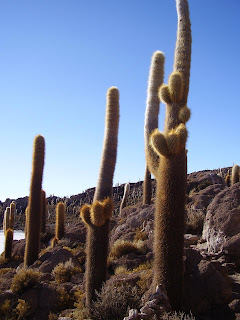 Nowadays there are no fishermen, of course, but the island is still worth visiting to see the forest of big cactus plants. It is managed by the Bolivian equivalent of DoC and an entry fee is levied.
 I woke up as we drew level with the Salt Hotel. This one is not only built oout of salt it is right in the salt plain.
Lonely Planet advises that this structure is illegal and that waste disposal damages the natural wonder that we have come to see. However, the authorities seem unwilling to do anything about it.
The swimming pool is simply a hole in the ground filled with water. It is, of course, salt water. Saltier than the sea I judged.
 Jeeps are not the only way to explore the salar. These cyclists had arrived the the salt hotel from Uyuni and set off towards Isla de los Pescadores, following the tyre tracks.
There was an end-of-adventure feeling as we drove the last few kilometres to the endge of the salar.
 And taken to the nearby settlement of Colchani where the salt is bagged.
Lunch was served in the building behind me. As we finished, another group passed by. Amongst them was Henk Konijnenbelt, whom I had first met on the Lake Titicaca trip. His family had returned to Amsterdam, but Henk had a little more holiday time and was making a whirlwind tour of Bolivia.
We had time to confirm that my email had been received and that we were both well before Henk had to rush to his jeep.
My departure was not far behind.
 We had now left the salt desert, but there were still mirages. I tried one more time to potograph the mountains apparently floating above the solid ground. Can you see it?
 Quite how some of them got there is a mystery, because there are gaps in the tracks. You can see how the front wheels of this locomotive are sitting tidily on rails, but the big driving wheels have sunk into the sand.
All that was left was to drop us off in front of the tour company´s office in Uyuni. Goodbyes were said, and promises made to keep in touch by email, although no mails have actully been sent.
I chose a modest hotel just along the street, the Victoria. A sigle room with shared bathroom was a mere 25 Bs. The shower in the shared bathroom was one of those electric heater at the showerhead jobs. But this one actually produced reasonably hot water. Shame on me for scoffing at Bolivian showers.
On some computers the pictures now look strangely dark. They were quite bright and normal when I loaded them. I hope they are OK on your screen.
 An unscheduled stop. The other "jeep" had pulled up and raised its bonnet. Our driver stopped and a rapid conversation in Bolivian Spanish ensued. Both drivers then grabbed spanners and tackled the problem.
For the mechanically minded I can report that the area of concern was soon narrowed to the pedals and the solution involved tying something with a plastic supermarket bag. I bet that´s not in the workshop manual.
For the next 24 hours we normally followed the companion vehicle. If we were ever ahead our driver would periodically stop and check that the other vehicle was still following.
On through the mountains we went. It still seems wrong somehow that so much of the route was parched and yet there were lakes.
 A puna flamingo photographed with all the zoom my little camera could manage. I was sure I wasn´t holding the camera steady enough, but it came out anyway. I should have used my little tripod, of course.
These lakes were smaller than Lago Colorado, where almost all the puna flamigoes breed. However, they had good populations in the non-breeding season. I think I saw some andean flamingoes as well but the main distinguishing features are the colour of the legs and the amount of black on the beak. Neither of these is easy to pick out at long range.
We visited lakes Ramaditas, Honda, Charcota, Hediondo and Canapa. Lunch was delayed until the last lake. This was a popular spot with the jeeps of several companies. It has therefore become known to the local wildlife.
 This andean fox was the most daring of the scavengers.
 This andean fox was the most daring of the scavengers.
There were a few caracaras gazing hopefully towards the lunch site, too. The fox would have to be pretty nippy to get in before these feathered pirates made a swoop.
Smaller birds fluttered to and fro pecking at the breadcrumbs and fallen rice grains.
 The flamingoes peacefully ignored the leavings of the humans and carried on filtering brine shrimp from the salty water.
The foreground is tussock and other grasses. the white bit is ice. The pinkish dots in the water are flamingoes. As you can see, the fine weather continued. There were a few clouds about, but I guess they were camera shy.
In the afternoon we encountered our first patches of salt desert. These were a rather grubby white. However, there were reflective enough to generate the first mirages. Vincent told us that they would not appear in snaps, but we still tried to photograph them anyway. I did take some photos of the terrain, but the main desert on the final day was so much more spectacular that I have not bothered to include the Day 2 pictures.
Our destination was another night´s lodging in the wilderness, but this time in a salt hotel. That is, quite literally, a hotel built out of salt. Blocks are cut out and used as bricks.
 The furniture is made of salt, too. These tables and stools show the layers very well. We asked why there were coloured strata in the salt bricks, but did not get an explanation.
The bed bases in our rooms were also constructed from salt. These were smaller than the dormitories of the previous evening, with only two beds per chamber. By some accident I got a room to myself.
Either we were significantly lower then the previous night, or the salt is a better insulator, but it didn´t feel nearly so cold. This emboldened one of the French guys to take a shower. He returned very quickly complaining that there was no hot water, despite the specific promises that had been made. Foolish man. Did he not realise that this was Bolivia. Hot showers indeed.
The reason for the non-delivery of hot water was very vague, but it transpired that nothing could be dome about it. Could the dirty tourist get a hot shower in the morning? Not a chance. The water will be frozen in the morning.
 Enjoying dinner off a salt table. From left to right the smiling faces belong to Vincent, the keen photographer; Guillermo, the French-speaking guide from the other jeep; and the lady from the other jeep.
If you wanted salt on your food you used the salt cellar. Breaking off bits of the furniture was just not done.
Vincent gave us a slide show of his photos. Not only did he have a large, expensive camera but he was travelling with a laptop in his luggage.
We were allowed two handfulls of twigs in the stove tonight. When half the lights were turned off to save power (the only electricity was from a solar cell) that was a clear sign that we should toddle off to our salt base beds with their piles of thick blankets.
 For reasons that were never very clear to me we had an early start in the morning. No-one attempted to have a shower.
 Enjoying dinner off a salt table. From left to right the smiling faces belong to Vincent, the keen photographer; Guillermo, the French-speaking guide from the other jeep; and the lady from the other jeep.
If you wanted salt on your food you used the salt cellar. Breaking off bits of the furniture was just not done.
Vincent gave us a slide show of his photos. Not only did he have a large, expensive camera but he was travelling with a laptop in his luggage.
We were allowed two handfulls of twigs in the stove tonight. When half the lights were turned off to save power (the only electricity was from a solar cell) that was a clear sign that we should toddle off to our salt base beds with their piles of thick blankets.
 For reasons that were never very clear to me we had an early start in the morning. No-one attempted to have a shower.
The sun rising above the salar.
I nearly missed breakfast because I chose this morning to drop a contact lens. I had carefully placed my universal plug in the sink so I knew is wasn´t down the drain, but it took an age to find.
However, I did get some breakfast and no-one seemed peeved that my pack was the last one to be loaded.
 Today was THE day when we were shown the biggest and whitest salt flat in Bolivia. This was what the whole tour was named after.
The first 100m from the salt hotel was pretty much like any jeep track and then we were on the desert, with a blinding white surface stretching before us.
 Today was THE day when we were shown the biggest and whitest salt flat in Bolivia. This was what the whole tour was named after.
The first 100m from the salt hotel was pretty much like any jeep track and then we were on the desert, with a blinding white surface stretching before us.
The jeep could have driven anywhere it wanted, but the drivers were very careful to stay in the tracks of previous vehicles and minimise the impact. The result was rubber-blackened trails on a brilliant white background.
 At one stage we stopped so that the tourists could get a close up view of the salt. It was hard and crunchy to walk over.
 At one stage we stopped so that the tourists could get a close up view of the salt. It was hard and crunchy to walk over.
 The irregularities in the surface are due, if I understood correctly, to the way the water evaporates out of the ground. These are only a few millimetres proud of the base level. They were barely noticeable from the jeep.
 As you can see, it is spirit-level flat. Every summer the rains come and the top of the salar is dissolved. The water then evaporates and the surface is renewed. I forgot to ask, but I imagine that the tracks across the surface are completely erased in the wet season.
There were mirages in almost every direction with mountains appearing to float above the horizon. On one occasion it seemed that I could see another jeep flying across the salar.
Our first destination was Isla de los Pescadores (Fishermen´s Island). There is something a little strange about an island in a sea of salt, but that is what it is.
 Nowadays there are no fishermen, of course, but the island is still worth visiting to see the forest of big cactus plants. It is managed by the Bolivian equivalent of DoC and an entry fee is levied.
These are a classical dry land cactus, with vertical concertina folds to allow expansion when water is abundant and can be stored, and contraction when it is being used by the plant.
You should be able to see a cactus-covered hillside here.
They are generously coated in the traditional long, sharp, straight spines. Bolivia is home to many species of cactus, but none more spectacular than these.
We had about an hour to scramble around a path that led to what I think was the highest spot on the island and take photos. I was down to my last set of camera batteries so I was not as extravagant as Victor.
 Energy could be spared for a picture that not only proves I made it to the top, but gives a basis for understanding the size of these plants.
If you can see the picture properly you will note that I had not shaved for several days.
Someone has calculated that the plants grow only 1 cm per year. One large specimen has been measured at 12.1 metres and the label solemnly declares that it is 1,210 years old. Happy birthday, cactus.
On my way back down to the jeep I saw some birds with yellow bodies and black heads, a sort of Jolly Hangman outfit.
They are generously coated in the traditional long, sharp, straight spines. Bolivia is home to many species of cactus, but none more spectacular than these.
We had about an hour to scramble around a path that led to what I think was the highest spot on the island and take photos. I was down to my last set of camera batteries so I was not as extravagant as Victor.
 Energy could be spared for a picture that not only proves I made it to the top, but gives a basis for understanding the size of these plants.
If you can see the picture properly you will note that I had not shaved for several days.
Someone has calculated that the plants grow only 1 cm per year. One large specimen has been measured at 12.1 metres and the label solemnly declares that it is 1,210 years old. Happy birthday, cactus.
On my way back down to the jeep I saw some birds with yellow bodies and black heads, a sort of Jolly Hangman outfit.
Off we went again, speeding over the salt and keeping to the established trail. The early start finally caught up with me and the smooth ride lulled me into a snooze.
 I woke up as we drew level with the Salt Hotel. This one is not only built oout of salt it is right in the salt plain.
Lonely Planet advises that this structure is illegal and that waste disposal damages the natural wonder that we have come to see. However, the authorities seem unwilling to do anything about it.
The swimming pool is simply a hole in the ground filled with water. It is, of course, salt water. Saltier than the sea I judged.
 Jeeps are not the only way to explore the salar. These cyclists had arrived the the salt hotel from Uyuni and set off towards Isla de los Pescadores, following the tyre tracks.
There was an end-of-adventure feeling as we drove the last few kilometres to the endge of the salar.
Here the salt is exploited commercially.
 First it is scraped up into little heaps. I was told the perfectly good reason for this but confess I have forgotten it.
 First it is scraped up into little heaps. I was told the perfectly good reason for this but confess I have forgotten it.
A silly pose for the camera.
The heaps are then shovelled onto trucks.
The heaps are then shovelled onto trucks.
 And taken to the nearby settlement of Colchani where the salt is bagged.
This was also the site of the salt museum, two rooms with some crude salt carvings and poorly stuffed birds. It was the poorest value I received, even though it was only 5Bs.
Colchani also boasts several souvenir stalls so I perused these and explained several times that my pack was too full to accomodate the offered trinkets.
 In the meantime our lunch was being prepared.
This vicuna was roaming Colchani, apparently without an owner. It was not tame and spat at a couple of tourists. However, it behaved itself while this picture was taken.Colchani also boasts several souvenir stalls so I perused these and explained several times that my pack was too full to accomodate the offered trinkets.
 In the meantime our lunch was being prepared.
Lunch was served in the building behind me. As we finished, another group passed by. Amongst them was Henk Konijnenbelt, whom I had first met on the Lake Titicaca trip. His family had returned to Amsterdam, but Henk had a little more holiday time and was making a whirlwind tour of Bolivia.
We had time to confirm that my email had been received and that we were both well before Henk had to rush to his jeep.
My departure was not far behind.
 We had now left the salt desert, but there were still mirages. I tried one more time to potograph the mountains apparently floating above the solid ground. Can you see it?
There are many stories of bad jeep drivers on this tour. There are some that get drunk and even fall asleep at the wheel. Our driver had been a model of sobriety.
I was thinking how well the trip had gone when we pulled up. This driver had put his head under the bonnet once or twice a day to make sure everything was running well so I was not concerned. Only this time there was a problem. We had run out of petrol.
The driver was properly embarrassed. He had driven the route many times before and there was no good reason why petrol consumption would have been higher than normal. We were, he assured us, only 10 minutes from Uyuni.
He flagged down the next vehicle headed our way and begged a lift into town. We stretched our legs and kicked stones into the dust. I looked around for birds but had no success. I did find a little memorial by the road. I couldn´t understand the inscription. Maybe this was someone who had been killed on the road. There did not seem to be any buildings nearby.
Our driver was back with a can of petrol sooner than we expected. He had hired a taxi for the return journey. The taxi was not a 4x4 and drove very circumspectly through the dust. In fact, we had refuelled so quickly that we got back to Uyuni before the taxi.
 We had one last stop on our itinerary. This was not a natural wonder, but the "Train Cemetery".
Bolivia once boasted a more extensive train network that it has today. As rolling stock becomes surplus to requirements something has to be done with it. In Bolivia it is taken to Uyuni and left in the sun.
The driver was properly embarrassed. He had driven the route many times before and there was no good reason why petrol consumption would have been higher than normal. We were, he assured us, only 10 minutes from Uyuni.
He flagged down the next vehicle headed our way and begged a lift into town. We stretched our legs and kicked stones into the dust. I looked around for birds but had no success. I did find a little memorial by the road. I couldn´t understand the inscription. Maybe this was someone who had been killed on the road. There did not seem to be any buildings nearby.
Our driver was back with a can of petrol sooner than we expected. He had hired a taxi for the return journey. The taxi was not a 4x4 and drove very circumspectly through the dust. In fact, we had refuelled so quickly that we got back to Uyuni before the taxi.
 We had one last stop on our itinerary. This was not a natural wonder, but the "Train Cemetery".
Bolivia once boasted a more extensive train network that it has today. As rolling stock becomes surplus to requirements something has to be done with it. In Bolivia it is taken to Uyuni and left in the sun.
The cemetery is mostly, but not exclusively, the last resting place - or is that rusting place - of locomotives. Anything that can be removed has gone, but the shells of these steam locos sit in the sun for any visitor to clamber over.
 Quite how some of them got there is a mystery, because there are gaps in the tracks. You can see how the front wheels of this locomotive are sitting tidily on rails, but the big driving wheels have sunk into the sand.
All that was left was to drop us off in front of the tour company´s office in Uyuni. Goodbyes were said, and promises made to keep in touch by email, although no mails have actully been sent.
I chose a modest hotel just along the street, the Victoria. A sigle room with shared bathroom was a mere 25 Bs. The shower in the shared bathroom was one of those electric heater at the showerhead jobs. But this one actually produced reasonably hot water. Shame on me for scoffing at Bolivian showers.
Golden Oldies Hockey
I am now in a grey and damp Buenos Aires. I have tried very hard to be interested in the city sights, but after a morning of pounding pavements in the rain I am happy to sit at a computer for a few hours.
I was going to write some more about Bolivia, but this Internet cafe does not provide CD drives, so I cannot upload any pictures. The scenery is such a major part of the Salar tour and the time around Tupiza that it is not much use writing about it without the photos. So I´ll deal with the hockey festival.
It is really a week-long party with hockey breaks. As the sole representative of Auckland´s Roskill Phoenix I had not entered a team of one player but instead was part of the Hampshire Harlequins. Officially this was a team from England, but there were 3 NZers and 3 Canadians in the squad.
We were due to start on the Sunday evening with a great parade of the teams at Rosario´s huge monument to the national flag. The organisation of the event was not good. It was not a disaster, but it was easily the weakest organised festival since Hong Kong in (I think) 1993. Our bus never showed up, so we had to walk to the parade, where our official team sign was conspicuously absent. Anyway we walked down the steps holding our banner aloft to the cheers of the teams already there.
The speeches of welcome could have been very tedious, but the speechmakers didn´t pause so the interpreters stood helplessly by as one half or other of the audience listened to a foreign language. At least that got it over with more quickly. These formalities were followed by some dancers. I´m sure they were introduced as a tango team, but there was no tango. However, they were dancing to the Benny Goodman arrangement of Sing, Sing, Sing, my very favourite tune so it was most enjoyable. Not a Goodman recording, though.
To make it even more memorable a stray dog wandered up the steps and joined the dancers on the stage. It wandered about and sniffed at some of the lighting gear, so 1,400 spectators were watching the dog, not the dancers. A stage hand tried to shoo the pooch away by swinging a boot at it. Not only was this totally futile, it drew boos from the dog-friends in the audience. The dancers, to their credit, ignored the interloper and carried on with their routine. As they finished the dog decended the steps to rapturous applause.
The next entertainment was a singer with a fine voice. Fido, sensing that the limelight was once again on the stage area, returned and sat appreciatively at the front of the stage. Most of us were helpless with laughter by this time.
We were also cold. The organisers could not be blamed for the unseasonal weather, but the function was running late and it was more than merely chilly. The singer was replaced by gaucho style dancers. They wear boots and kick them about so the dog wisely retreated a bit, but a good actor can tell when he is lit and when he is not. The dog kept to the edge of the stage where everyone could see him. The shivering Harlequins had become spread out in the crowd, but all those that capitano Norman could find joined a quiet drift towards the hotel where food, drink, light and warmth were waiting for us.
It was great to be early. Squads of waiters and waitresses were desperate for someone to serve their drinks to and we happily obliged. Piled plates were descended on by ravenous hockey enthusiasts. Our arrival was the signal to retrieve the hot food from some caterer´s secret place and ladle it onto our plates. Through the hotel´s windows we admired the fireworks that marked the end of the official ceremony. After three helpings and as many glasses of red wine I beamed benevolently at the throng who streamed in after staying at the monument for the full official schedule.
Then the first band started. This was definitely my evening. It was a swing jazz trio of great skill. Keyboard, drums and bass are an unusual combination but they made it work well. Between numbers I asked if they had a CD. They hadn´t brought any with them!
The next band was for dancing to, and didn´t the Argentinians do that! They were nearly all women´s teams and they swarmed onto the floor. Not that the foreigners were far behind. I was in there jigging with the best of them. At one time I was surrounded by a circle of admiring Argentinian women. My ego may one day return to normal size.
We returned to the hotel to find the arrangements for Monday´s games on the noticeboard. Oh no. We were a mixed team but had been set down to play against men´s teams. We noted the time of our bus and went to our beds.
The next morning the bus did turn up, it was just ridiculously late. All the games had to be played later than scheduled as the teams turned up. It later emerged that these were buses from another city. Maybe the drivers just didn´t know how long it would take to get to the hotels. But we did eventually get to the grounds and we did play against the men. We actually gave the Dutch 65-and-over team a reasonable game but against the Newcastle Hunters from Australia it was very one-sided. However, we did score two breakaway goals. I scored one of them. I usually score one goal per festival.
Tuesday was a picnic at an estancia some way outside Rosario. The bus was on time. At the estancia there were plenty of tables, chairs and waiters who would produce beer or other beverages on request. Delightful finger foods were distributed at appropriate times throughout the day. I fraternised with other teams from many countries.
There was also entertainment. More dancing. This time both men and women in traditional garb. I didn´t see any booted feet kicked out. My sample was a cross between country dancing and flamenco. Then some gauchos gave a demonstration of horsemanship. There was an explanation of what was being done and if you knew horses you would have properly appreciated the skills involved. I fear I am a non-horse person. Finally there was a demonstration of polo. A bit of explanation would have been useful here, too, but it was not offered. At least I can say that I have seen polo live. The rules are a mystery still. The referee was mounted, but did not make any attempt to keep up with the play. Indeed, he did not appear to have a whistle. Very odd. I am incredibly impressed that a player can hit a ball with that long-handled mallet from a moving horse. But they hardly ever missed.
Despite our earlier requests for games against other mixed teams, we were set down to play in a men´s section once more on Wednesday. We protested and this time the draw was redone instantly. Hooray, we got games against the Galway Hookers and the Bath Buccaneers. Mind you, we had to tell our scheduled all-male opponents that their day´s arrangements had been changed. They were both afternoon games, so we spent the morning trying not to drink too much beer, swapping team badges and making new friends. However, the language barrier was awkward and usually prevented long conversations with the local teams. I did have a few words with the sole team from Paraguay. They were very impressed that I had visited their country.
The Galway Hookers were a mixed team that played pretty serious hockey, and we didn´t fare well. Then it transpired that the Bath Buccaneers were mainly the same people and we had another hard game. There were some unfortunate collisions and a few players got rather grumpy. Not the Golden Oldies spirit at all. However, we kept a clean sheet and recorded our first draw.
After the Wednesday games the teams were invited to "strut their stuff". Hampshire Harlequins had registered to do a turn but (a) we hadn´t rehearsed, (b) there were so many teams performing that we estimated it would go on until at least 11pm, and (c) it was cold. We scratched. We did go through our songs round our table near the bar and even got three Paraguayans to join in singing, amongst other things, Maybe It´s Because I´m a Londoner. Then we sang them again on the bus going back to the hotel.
I had a "rest" day on Thursday. This involved getting a load of laundry done; finding a shoe repair place to re-sole my tramping boots and re-sew the other strap on my day pack; getting my camera downloaded to CD; writing a postcard to my computerless parents; sending birthday greetings to my daughter Elizabeth and finishing off the Ruta Uno story on my blog.
Many others went on tours around the area. One was a disaster. There was a border to cross (presumably into Uruguay) and the bus didn´t have the right paperwork. They were held up for hours and the monastery or whatever they were going to see was closed when they got there. They did get refunds.
Having got the message through that we were a mixed team, imagine our feelings when the draw for Friday had us playing men´s teams yet again. I made some phone calls and was promised all would be fixed by the morning. In the morning we were removed from the men´s section but had no games at all. I fear I would have got very frumpy indeed at this, but our liason person, Laura, promised to sort it out. And she did. We finally got three games against relaxed, social, mixed teams who wouldn´t try very hard.
We had three lovely games. No-one had to run hard. No-one got grumpy. We even played a silly manouvre against the Fijians. When defending a short corner, on the cry of "Bomburst" we all ran and hid behind our own goal.
Saturday is for aged bodies to recuperate and then let rip at the farewell party.
The venue was at a shopping mall, of all places. The table numbering was odd. It wasn´t random because 95 was close to 97, but the next table was numbered 43. We found our tables by wandering like particles demonstrating brownian motion until we came across them.
During the period when the 1,400 participants were arriving couples gave tango demonstrations on rostra. I didn´t realise it was necessary in tango to get so close. A tango band played. It was an idiosyncratic ensemble with 4 or 5 accordions and they played very avant-garde music. I didn´t meet anyone who said they liked it. The tango dancers appeared on the main floor and, with more space, danced somewhat further apart.
Then the organisers from Air NZ and the local committee made lots of speeches and gave each other lots of presents. Since they had done a pretty ordinary job of it, this got tedious. Food was then served while the accordions played yet more atonal music. They finally left to the most meagre of polite applause. Now, I thought, we can party, except that there was no music at all. I started to dance anyway, which at least got a laugh. And then some tango music started and a few of us danced to that. No, I didn´t try to dance the tango.
We didn´t appreciate that this music was for the professionals AGAIN. I was actually asked to leave the floor. Above the music I tried to explain that there were 1,400 people who had come here to party. I think it was about 11 o´clock at this stage. By now there were more and more Golden Oldies getting up and dancing. I believe the organisers gave up. I saw at least one of the tango troupe bopping with the rest of us.
My legs gave out at about 2:20. I got to bed at 3:00 and had to be up at 7:30 to pack in time for the bus to Buenos Aires.
I was going to write some more about Bolivia, but this Internet cafe does not provide CD drives, so I cannot upload any pictures. The scenery is such a major part of the Salar tour and the time around Tupiza that it is not much use writing about it without the photos. So I´ll deal with the hockey festival.
It is really a week-long party with hockey breaks. As the sole representative of Auckland´s Roskill Phoenix I had not entered a team of one player but instead was part of the Hampshire Harlequins. Officially this was a team from England, but there were 3 NZers and 3 Canadians in the squad.
We were due to start on the Sunday evening with a great parade of the teams at Rosario´s huge monument to the national flag. The organisation of the event was not good. It was not a disaster, but it was easily the weakest organised festival since Hong Kong in (I think) 1993. Our bus never showed up, so we had to walk to the parade, where our official team sign was conspicuously absent. Anyway we walked down the steps holding our banner aloft to the cheers of the teams already there.
The speeches of welcome could have been very tedious, but the speechmakers didn´t pause so the interpreters stood helplessly by as one half or other of the audience listened to a foreign language. At least that got it over with more quickly. These formalities were followed by some dancers. I´m sure they were introduced as a tango team, but there was no tango. However, they were dancing to the Benny Goodman arrangement of Sing, Sing, Sing, my very favourite tune so it was most enjoyable. Not a Goodman recording, though.
To make it even more memorable a stray dog wandered up the steps and joined the dancers on the stage. It wandered about and sniffed at some of the lighting gear, so 1,400 spectators were watching the dog, not the dancers. A stage hand tried to shoo the pooch away by swinging a boot at it. Not only was this totally futile, it drew boos from the dog-friends in the audience. The dancers, to their credit, ignored the interloper and carried on with their routine. As they finished the dog decended the steps to rapturous applause.
The next entertainment was a singer with a fine voice. Fido, sensing that the limelight was once again on the stage area, returned and sat appreciatively at the front of the stage. Most of us were helpless with laughter by this time.
We were also cold. The organisers could not be blamed for the unseasonal weather, but the function was running late and it was more than merely chilly. The singer was replaced by gaucho style dancers. They wear boots and kick them about so the dog wisely retreated a bit, but a good actor can tell when he is lit and when he is not. The dog kept to the edge of the stage where everyone could see him. The shivering Harlequins had become spread out in the crowd, but all those that capitano Norman could find joined a quiet drift towards the hotel where food, drink, light and warmth were waiting for us.
It was great to be early. Squads of waiters and waitresses were desperate for someone to serve their drinks to and we happily obliged. Piled plates were descended on by ravenous hockey enthusiasts. Our arrival was the signal to retrieve the hot food from some caterer´s secret place and ladle it onto our plates. Through the hotel´s windows we admired the fireworks that marked the end of the official ceremony. After three helpings and as many glasses of red wine I beamed benevolently at the throng who streamed in after staying at the monument for the full official schedule.
Then the first band started. This was definitely my evening. It was a swing jazz trio of great skill. Keyboard, drums and bass are an unusual combination but they made it work well. Between numbers I asked if they had a CD. They hadn´t brought any with them!
The next band was for dancing to, and didn´t the Argentinians do that! They were nearly all women´s teams and they swarmed onto the floor. Not that the foreigners were far behind. I was in there jigging with the best of them. At one time I was surrounded by a circle of admiring Argentinian women. My ego may one day return to normal size.
We returned to the hotel to find the arrangements for Monday´s games on the noticeboard. Oh no. We were a mixed team but had been set down to play against men´s teams. We noted the time of our bus and went to our beds.
The next morning the bus did turn up, it was just ridiculously late. All the games had to be played later than scheduled as the teams turned up. It later emerged that these were buses from another city. Maybe the drivers just didn´t know how long it would take to get to the hotels. But we did eventually get to the grounds and we did play against the men. We actually gave the Dutch 65-and-over team a reasonable game but against the Newcastle Hunters from Australia it was very one-sided. However, we did score two breakaway goals. I scored one of them. I usually score one goal per festival.
Tuesday was a picnic at an estancia some way outside Rosario. The bus was on time. At the estancia there were plenty of tables, chairs and waiters who would produce beer or other beverages on request. Delightful finger foods were distributed at appropriate times throughout the day. I fraternised with other teams from many countries.
There was also entertainment. More dancing. This time both men and women in traditional garb. I didn´t see any booted feet kicked out. My sample was a cross between country dancing and flamenco. Then some gauchos gave a demonstration of horsemanship. There was an explanation of what was being done and if you knew horses you would have properly appreciated the skills involved. I fear I am a non-horse person. Finally there was a demonstration of polo. A bit of explanation would have been useful here, too, but it was not offered. At least I can say that I have seen polo live. The rules are a mystery still. The referee was mounted, but did not make any attempt to keep up with the play. Indeed, he did not appear to have a whistle. Very odd. I am incredibly impressed that a player can hit a ball with that long-handled mallet from a moving horse. But they hardly ever missed.
Despite our earlier requests for games against other mixed teams, we were set down to play in a men´s section once more on Wednesday. We protested and this time the draw was redone instantly. Hooray, we got games against the Galway Hookers and the Bath Buccaneers. Mind you, we had to tell our scheduled all-male opponents that their day´s arrangements had been changed. They were both afternoon games, so we spent the morning trying not to drink too much beer, swapping team badges and making new friends. However, the language barrier was awkward and usually prevented long conversations with the local teams. I did have a few words with the sole team from Paraguay. They were very impressed that I had visited their country.
The Galway Hookers were a mixed team that played pretty serious hockey, and we didn´t fare well. Then it transpired that the Bath Buccaneers were mainly the same people and we had another hard game. There were some unfortunate collisions and a few players got rather grumpy. Not the Golden Oldies spirit at all. However, we kept a clean sheet and recorded our first draw.
After the Wednesday games the teams were invited to "strut their stuff". Hampshire Harlequins had registered to do a turn but (a) we hadn´t rehearsed, (b) there were so many teams performing that we estimated it would go on until at least 11pm, and (c) it was cold. We scratched. We did go through our songs round our table near the bar and even got three Paraguayans to join in singing, amongst other things, Maybe It´s Because I´m a Londoner. Then we sang them again on the bus going back to the hotel.
I had a "rest" day on Thursday. This involved getting a load of laundry done; finding a shoe repair place to re-sole my tramping boots and re-sew the other strap on my day pack; getting my camera downloaded to CD; writing a postcard to my computerless parents; sending birthday greetings to my daughter Elizabeth and finishing off the Ruta Uno story on my blog.
Many others went on tours around the area. One was a disaster. There was a border to cross (presumably into Uruguay) and the bus didn´t have the right paperwork. They were held up for hours and the monastery or whatever they were going to see was closed when they got there. They did get refunds.
Having got the message through that we were a mixed team, imagine our feelings when the draw for Friday had us playing men´s teams yet again. I made some phone calls and was promised all would be fixed by the morning. In the morning we were removed from the men´s section but had no games at all. I fear I would have got very frumpy indeed at this, but our liason person, Laura, promised to sort it out. And she did. We finally got three games against relaxed, social, mixed teams who wouldn´t try very hard.
We had three lovely games. No-one had to run hard. No-one got grumpy. We even played a silly manouvre against the Fijians. When defending a short corner, on the cry of "Bomburst" we all ran and hid behind our own goal.
Saturday is for aged bodies to recuperate and then let rip at the farewell party.
The venue was at a shopping mall, of all places. The table numbering was odd. It wasn´t random because 95 was close to 97, but the next table was numbered 43. We found our tables by wandering like particles demonstrating brownian motion until we came across them.
During the period when the 1,400 participants were arriving couples gave tango demonstrations on rostra. I didn´t realise it was necessary in tango to get so close. A tango band played. It was an idiosyncratic ensemble with 4 or 5 accordions and they played very avant-garde music. I didn´t meet anyone who said they liked it. The tango dancers appeared on the main floor and, with more space, danced somewhat further apart.
Then the organisers from Air NZ and the local committee made lots of speeches and gave each other lots of presents. Since they had done a pretty ordinary job of it, this got tedious. Food was then served while the accordions played yet more atonal music. They finally left to the most meagre of polite applause. Now, I thought, we can party, except that there was no music at all. I started to dance anyway, which at least got a laugh. And then some tango music started and a few of us danced to that. No, I didn´t try to dance the tango.
We didn´t appreciate that this music was for the professionals AGAIN. I was actually asked to leave the floor. Above the music I tried to explain that there were 1,400 people who had come here to party. I think it was about 11 o´clock at this stage. By now there were more and more Golden Oldies getting up and dancing. I believe the organisers gave up. I saw at least one of the tango troupe bopping with the rest of us.
My legs gave out at about 2:20. I got to bed at 3:00 and had to be up at 7:30 to pack in time for the bus to Buenos Aires.
Subscribe to:
Posts (Atom)