03 February 2019

Washington (October 2018)

After the complications of visiting New York, Washington was a breeze.

Back in Nova Scotia (see the post of 17 November 2018) we had met a nice couple from Washington, Don and Sarah Fish. They had recommended driving to Greenbelt Station and taking the Metrorail from there. Internet research located a campground in the Greenbelt National Park. This was not only very conveniently located, its tariff was a modest $20 per night.

Our programme was a simple one: stay two nights at the campground and see the main sights of Washington DC in the intervening day. We know there are a ton of things to do in Washington, but exploring the various branches of the Smithsonian just didn't appeal to us at the time. This was back in mid-October 2018 and the memory of why we were in a hurry to move on has grown faint. We were also invited to dinner by Don and Sara.

Malcolm-Edgar, our GPS, led us through Washington's maze of busy roads to the campground. It turned out to be not only conveniently located and inexpensive, but also very attractive. You'll have to rely on our word for it, though, since we didn't take any photographs.

After the difficulties of the Port Credit station's very small parking lot, described in Where do we stay while on the road? posted on 2 September 2018, we were a bit apprehensive that the Greenbelt station's lot would be full, although Don Fish had promised that it is a good, big one. We shouldn't have worried. The parking lot is HUGE and there were acres of empty spaces. There are even spaces specifically for large vehicles like ours, but they were so far away we didn't notice them. We offered to move to the designated area, but we were told it didn't matter. Clearly it wasn't expected to be a busy day.

To ride Washington's Metro you must have a SmarTrip fare card. They cost $10 each and are delivered with $8 credit. You tap on and off, the fare is automatically computed and deducted from your balance. Easy peasy.

From Greenbelt it was one simple change to Union Station where the Big Bus hop-on hop-off buses start. Excuse the advertisement, but they were SO much better than the company we used in New York. Part of the delight was the much better weather and the freer circulation of the traffic, but the guides were better and, a key thing for us, they didn't keep begging for tips. We were given accurate information about the best changes to make so that we rode the complete network of 3 routes in one day.

The Capitol

The Lincoln Memorial

The Washington Monument

The National Museum of African American History and Culture. This is the newest part of the Smithsonian and extremely well patronised. You have to arrive very, very early or queue for hours to get in.

The one satellite of the Smithsonian network that we did visit was the zoo. This was partly to satisfy our liking for natural history, but mainly because it was lunch time and zoos always have a cafe.

The Smithsonian is a remarkable organisation. Not only must it be the largest museum operator in the world, but in the capital city of capitalism all its establishments are free entry.

The Washington zoo is most proud of its giant pandas. So we had to go and have a look.

It was snack time in the giant panda house.
The red pandas were more active.
Crumbs dropped outside the cafe didn't last long with this starling and his mates around.

The White House was the last of the important buildings we saw. Freedom of speech was being exercised by a woman who appeared to be preaching, rather than airing a political opinion. A cyclist rode by and raised one hand aloft, his middle finger explaining his dissatisfaction with the President's conduct.

The standard tourist's view. The man holding the banner was trying to raise funds to help children in Haiti.

Back at Union Station we checked the Metro fare back to Greenbelt. You need to be careful as the tariff varies with the time of day. We topped up our SmarTrip cards to the exact amount needed for our journey.

We understood that parking could be paid either with a SmarTrip card or with cash. We had nil balances on our SmarTrip cards but we had cash. The first exit we approached had no attendant and the machine accepted only plastic. We turned around – not an easy manoeuvre for a 28ft vehicle – and tried the other exit where, according to a sign, a cashier was to be found. Again it was unmanned and taking only cards. In desperation we returned to the first gate and offered a debit card. A green light glowed and the barrier rose. Why couldn't they say that debit cards were accepted?

The route to Don and Sarah's house took us along sections of multi-lane highways. It was past the peak of the rush hour, but traffic was still heavy. Changing lanes was not easy in the dusk, but we made it without incident.

The food and the conversation were excellent. We had a lovely time.

Thank you Don and Sarah.

It was, of course, dark when we started back to the campground. We had done very little night time driving. Judging speeds and distances when we had to change lane was tricky, but by now traffic was light and most American drivers seem to be considerate. As we approached the park we used full beam for perhaps the first time on the trip. The lights gave good illumination of the road ahead – and then they went out! Frantically working the light switch brought them back on, but it happened three more times before we reached our campsite. Clearly we had an electrical problem with Gregory. No more night driving until it was fixed.

Someone, we think it was Don, had recommended the Shenandoah National Park as being worthy of a visit. To get there we had to circle around Washington and take Interstate 66. We set Malcolm-Edgar and off we went. We had no practical alternative to using the interstate highways, and we seemed to encounter more than our fair share of highways that split and where we had to move across two or three lanes to take the leftwards option.

Signs started appearing to warn us of tolls ahead. Malcolm-Edgar is programmed to avoid tolls, but it's not the end of the world if we have to pay one or two. Except that the signs started alerting us that only electronic payment was accepted, and we don't have the magic device that you need for this system. When a sign said “Last Exit Before Toll” we took it. It was a road to Washington's main airport, Dulles. We ended up following it right into the airport and past the departure drop-off zone. Then when we left the airport we could see the road we came in by for a few miles before we peeled off and made our way to I66 without having to pay a toll.

There's never a dull day when you are travelling.

02 February 2019

A murder before our eyes

It's not often you get to witness a murder, especially just outside the window in the back garden AND get to photograph it. 

The victim was a pigeon. The perpetrator looks something like a buzzard, but is not large enough.  The best suggestion made so far is a female Sparrowhawk.  Positive identification will help naturalists, but not police, with their enquiries.


The homicide in progress.  Considering that the picture was taken through the glass of the french door it’s quite sharp.  

A mug shot of the killer.  Do you know them?


A holiday within a holiday.

On 18 December we flew out of the United States. Our permission to visit the country was about to expire and we have to spend at least 90 days outside North America before we can return. We left Gregory, our motor home, in storage in Florida. All the water tanks are drained and the engine battery is disconnected. Hopefully the motor will start without assistance when we return in March.

We flew to London, via Reykjavik. Why via Reykjavik? Because we plan to break the return journey there for a few days in Iceland.

Bill's brother Nigel had arranged for a taxi to meet us at the airport and take us directly to his home in Shaftesbury, Dorset. We had some difficulty contacting the driver, Peter. He likes to use Whatsapp, so we had set this up and tested it while we were in Florida. But something went wrong at Heathrow, because we both sent messages and none of them were delivered. Luckily Peter knows Nigel well and saw a resemblance in Bill, so all was well.

Nigel would have met us himself, but he is in New Zealand. It's a long story.

So we settled down to spend 3 months based in Nigel's house and with the use of his car. After almost 7 months of nearly non-stop travelling it has been very restful. We know each morning where we will spend that night. We have the luxury of unlimited Internet data, and can even watch TV if we so wish. We have done a lot of reading.

We can walk to a supermarket in 4 minutes, and Shaftesbury is a typical English country town**, with stone buildings, narrow streets and still-cobbled Gold Hill, whose image is the subject of many chocolate boxes, jigsaw puzzles and TV commercials which want to deceive the consumer into thinking that the product is traditional.

**Mike Theilmann has taken issue with this comment.  In his opinion Shaftesbury is head and shoulders above most other English country towns in charm and location.  Quite exceptional in fact.  (We've corrected your spelling of Shaftesbury, Mike.)

It's been cold outside, but the house is centrally heated and very cozy. There is a wood-burner in the lounge which adds a pleasant view of glowing embers to the room as well as heat.

Compared to life in the months charging about North America we have been quite slothful, but we have spent time with friends and got about a bit. Dorset has many country lanes that were created in horse-and-cart days. The established houses, dry-stone walls and hedges constrain the width of the roads, sometimes severely, and are more effective than road signs at enforcing the speed limit.

Typical Dorset countryside.  The cleared area on the valley floor is a long, thin ploughed field, not a road or a river.

The black diagonal stripe on the white circle indicates that the open road speed limit applies in the side lane.  That's 60mph, but you'd have to be insane to drive that fast.

A relatively major road - it has two full lanes and a centre line!

Not all the roads are claustrophobic.  This is in the New Forest, Hampshire.

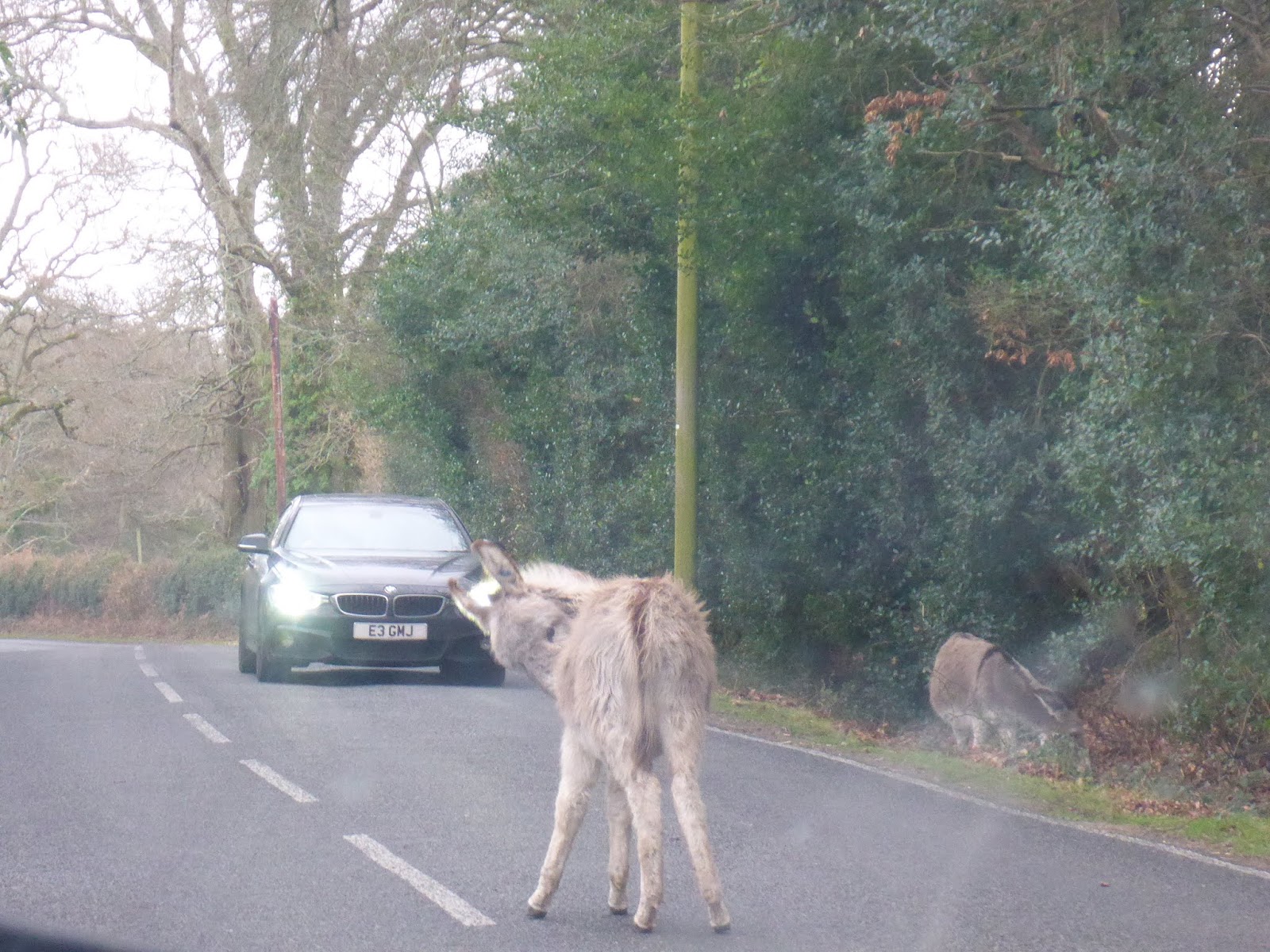
But there are other hazards - New Forest ponies roam free ...

... and this donkey just didn't care.

At Fovant, near Shaftesbury, some Army units have carved their badges in the chalk hillside.

The river at Weymouth.

Further afield we have visited Eve's sister-in-law near Birmingham and Bill's son and his family in Meltham, Yorkshire. Future plans include Cornwall, Winchester and London.

Today we are not going anywhere. It is snowing. Nothing, of course, to compare with the effects of the Polar Vortex in Canada and the USA, but more than the UK can properly cope with. Yesterday cars were abandoned in Cornwall, on a road we are planning to drive next week! It is forecast to clear up today, but I don't think so.

It was still snowing when the picture was taken.

A scene from the Sub-tropical Gardens at Abbotsbury.  Try and picture them under today's snow.

Nigel will return later this month, and we will have his company for about 3½weeks. We are very much looking forward to that.

Due to the relaxing effect of a warm, cosy house, we have added only a couple of posts to the blog. We will make an effort to bring it up to date. Tomorrow. Maybe.

20 January 2019

The Other Bill Heritage

A few years ago Bill's brother Nigel discovered that there was another Bill Heritage. This one lives in America and owns a winery. Bill did send an email to the winery, but got no reply. The William Heritage Winery is in Mullica Hill, New Jersey. It is not far away from Longwood Gardens so we tried just turning up.

It was initially disappointing. The NJ Bill (actually a William) was not on the premises. However, his wife was, and we had a most agreeable chat with Penni Heritage.

The big question was, of course, “Are we related?” The New Zealand Heritages are a branch of the Oxfordshire/Warwickshire Heritages in England. There is one known link to America. NZ Bill's great great grandfather, Caleb Heritage, had a brother Joshua who emigrated to the United States. We even have a copy of a photograph he sent back to England. Penni had no knowledge of an ancestral Joshua Heritage, and produced a beautifully drawn family tree that traced William's family back to an Eli Heritage.

Eli was born well before Caleb; probably one or maybe two generations further back. We photographed the tree and sent it to the genealogists in the Oxon/Warwicks tribe, but no connection has yet been established.

Penni generously gave us a complimentary tasting of some New Jersey Heritage wines, and we bought a couple of bottles that merited more than just a taste.

Longwood Gardens, Pennsylvania

Before we leap into a description of the gardens and the photographs there is a little bit of history to explain why we went there.

Bill's father (Bill Snr.) was England's leading expert on garden ponds and a member of the International Water Lily Society. Indeed, he was inducted into the IWLS Hall of Fame. He modestly described this achievement as “They like to induct someone every year and they ran out of people who deserved it.” Bill's parents made many friends through the IWLS. Among them were Patrick Nutt and his wife, Ann. After Bill Snr. ceased active participation in IWLS letters were still exchanged and by 2018, after most of the principals in this story had died, we were left with Ann Nutt's email address in Bill Junior's address book. We let her know we were going to be in the area and asked if we could pop in and say “Hello”.

Ann suggested that we meet at Longwood Gardens. At that stage the name meant nothing to either of us, since Bill Snr. had talked to us only about the people, not their connection to water lilies. We assumed that there would be water lilies at the gardens, although they would not be at their best when we were there in mid October.

Yes, there are water lilies and many other flowers, but first we learned a lot more about the IWLS relationship and Longwood Gardens. Bill Snr. and Patrick shared a love of water lilies and an air force background. They had lots to talk about and got on extremely well together. Patrick was a horticulturist at Longwood Gardens and he, too, had been inducted into the Hall of Fame for successfully hybridising Victoria cruziana and Victoria amazonica (the Amazon lily with leaves the size of café table-tops).

Some pygmy water lilies can be grown in a container little bigger that a goldfish bowl. You need a pond the size of a swimming pool to keep Longwood Hybrid happy.

Its flower is not the usual water lily 'star'.

We were introduced to some of the current Longwood horticulturists, who remembered Bill Snr. very well. They also clearly admired him as an expert in his field. Tim, who now fills Patrick's senior role at the Gardens, was eager to show us Bill Snr.'s books in the extensive Longwood library, but they couldn't be found. We will be remedying the omission soon.

Tim, whose surname we omitted to write down ,and Ann Nutt.

We conveniently left the library just before the fountain garden played. There are scores of fountain jets that are 'choreographed' to go with music.

At full blast.

Some jets can sway from side to side.

A cunningly formed water 'basket'.

The whole performance took about 20 minutes. The last piece was Nessum Dorma sung by Pavarotti. Eve found it so beautiful she cried.

Ann guided us on a tour of the Gardens. Here are a selection of the blooms on display:

Cleome (Spider flower)
Dahlias
More dahlias

Does your garden incorporate a train set?

Thomas the Tank Engine brings movement to this border.

31 December 2018

New England

The New England states are world famous for the spectacular colours of the trees in the autumn. The Americans, in their perverse way with the English language, call it the fall.

We set off from Brunswick, Maine on 30 September and headed for the White Mountains in New Hampshire. A young man in an information center suggested the Kancamagus Highway as being the most scenic drive through the very scenic mountains. Even getting there was a visual treat.


 Not all the colour was in the leaves.


A selection of fallen leaves.

 Maple leaves don't change colour evenly over the whole leaf.

And remember that our best information was that the colours would be even better a week later.

There's wildlife in the White Mountains, too. We saw moose on two occasions.

In Vermont we walked a trail dedicated to Robert Frost, an American poet. There are information boards along the way with excerpts from his work.

This squirrel allowed us to approach quite closely.

The autumn/fall colours in Vermont are much the same as in the White Mountains. We didn't get tired of seeing them.


We found a large parking area at the Dead Creek Wildlife Management Area. Free parking for up to 72 hours if you are engaged in a permitted activity, such as bird watching or wildlife photography. We watched many skeins of geese heading South, but didn't get any worthwhile photographs.

In New York State we drove down the West shore of Lake George. It was named after an English king and for some reason didn't get renamed after independence.

In Ashfield, Massachusetts we stopped for lunch at a rest area provided by the town. A dog barked at Bill as he went outside to turn on the gas. The owner hurried up. “She won't hurt you.” And that's how we met Dick Seebeck. We had a very pleasant chat and he invited us to visit his home and meet his wife. Which we did, and thus met Margaret Seebeck. They are a charming couple and we still exchange occasional emails.

Margaret and Dick Seebeck. The sun was in a most unsuitable position for the photo. Sorry.

By the time we got to Rhode Island we were getting a bit grumpy with each other. Eve found the solution – take a break. So we had two nights in the Burlinghame State Park campground.

Nothing like a camp fire for inducing a good feeling.

For our non-travelling day we not entirely idle. We visited the Ninigret National Wildlife Refuge, which was all of 5 minutes along the road. It is the site of a WWII airfield, so there is no climbing involved in following the trails.

Not much in the way of leaf colours, but plenty of autumn flowers …

… and berries.


This bumblebee was working late in the year.

A rabbit that hopped out of the undergrowth and posed in camera range.

After our day's rest we became concerned with getting to see New York city (see the post of 30 October), and did not do Connecticut justice. We drove across it, avoiding the major cities, but there are no photographs from that journey.