24 November 2018

Farewell to Canada

If you are travelling Southbound and take the first exit from the Confederation Bridge in New Brunswick you are delivered to the Cape Jouriman Nature Centre. It doubles as a place to catch the shuttle bus. If your work took you frequently between Prince Edward Island and New Brunswick you might get ticked off about paying a $45 toll for every return trip, so you can leave your vehicle and catch the shuttle bus. We were told that a number of local folk have calculated that it is cheaper to own a car in each province and take the shuttle across the bridge.

There is no problem about parking in the gravel lot for shuttle riders, but the man at the Nature Centre gate allowed us to park on the centre's nice, level, asphalt parking lot.

Arrival in New Brunswick meant that we had visited all the Canadian provinces and territories except Nunavut. And there are no roads into Nunavut, which includes large sparsely inhabited tracts of mainland Canada, Baffin Land and all the other major Arctic islands. Nunavut is certainly worth exploring, but it is difficult and expensive to do so.

The Cape Jouriman Nature Centre is not the least of New Brunswick's attractions. We enjoyed the information to be found inside, and then walked a short nature trail ...


… where we encountered this rabbit …

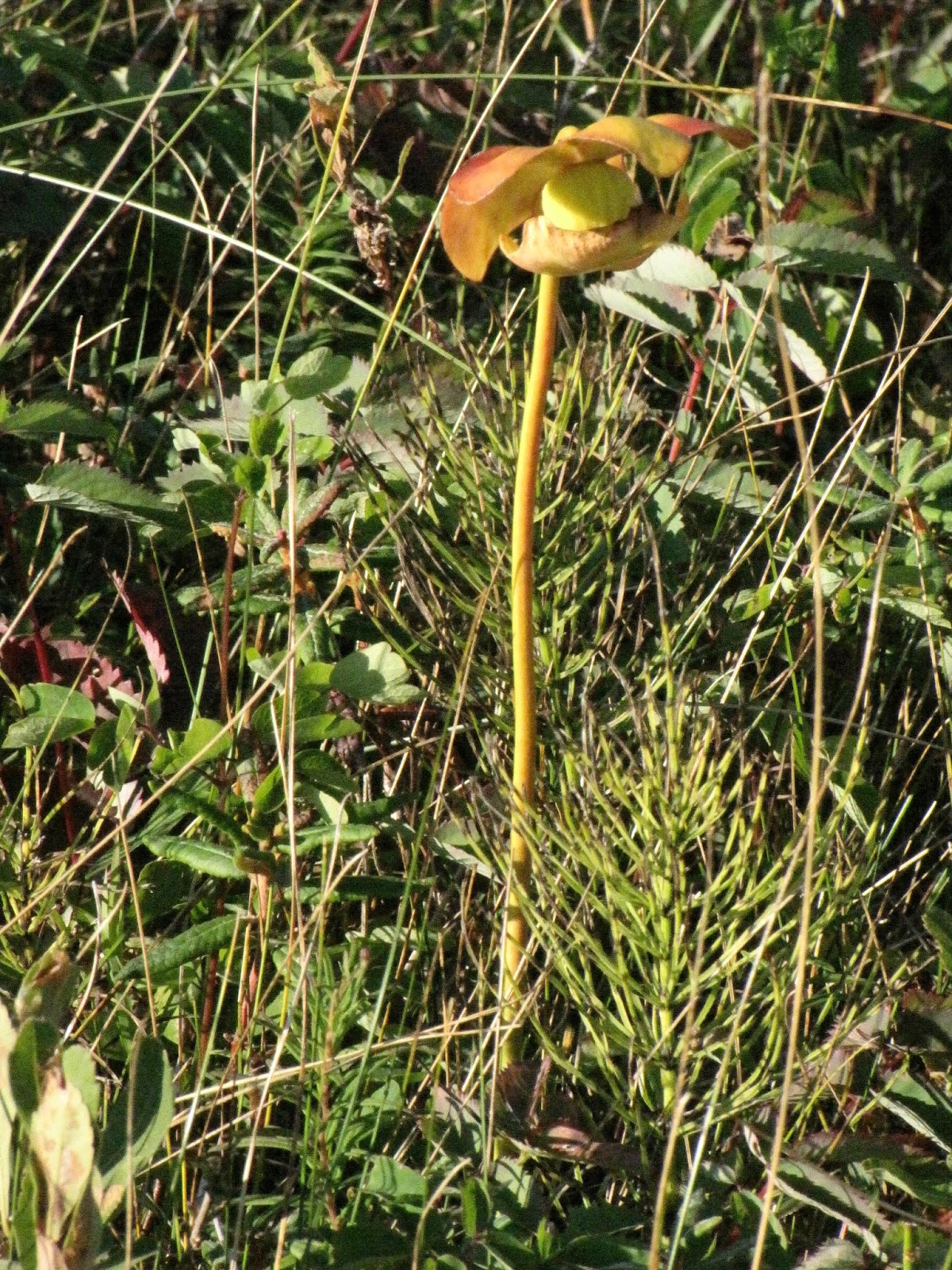
… and these flowers.

New Brunswick's coast is one shore of the Bay of Fundy, famous for having the highest tides in the world. One of the must-see features on the shore is the Hopewell Rocks, but we managed to arrive when the tide was dead wrong and you have to pay a significant fee before you can assess whether there is still anything worth seeing. The high tide would certainly have covered an awful lot as it rose its 40 feet (12 metres) or whatever it is. So we didn't see the Hopewell Rocks. We later met a couple who had visited them at high tide and their assessment was that it was still worthwhile. Damn.


Now why would you name a restaurant “Fred's”? Fred may be an excellent chef but, to us, the name lacks market appeal. Isn't prejudice a terrible thing? We were self-catering anyway.

We were much more successful at Saint Martins.
  • We did see the sea caves. 
  • We decided it was time for a paid campground and we found a very nice one.
  • Eve finally got her birthday present.
The latter needs elaboration. Bill promised Eve that, for her birthday, she would have a lobster dinner. On the actual day we were in Alberta, which has no coastline and therefore no lobsters. During our travels we had been solemnly promised that the best lobsters were to be found in Newfoundland, in Nova Scotia, in New Brunswick and in Maine. Our various informants were, as you might have guessed, residents of one of those provinces.

The campground recommended one of the two cafes by the sea caves and we each ordered the lobster dinner. Whilst it was well outside the hamburger price range, in truth the tariff was reasonable. Compared to New Zealand's crayfish it was dirt cheap. We each got a whole lobster and a device similar to nutcrackers to help with removing the shell. There were also some chips and lots of butter. Neither of us can remember any green vegetables with the meal. It was delicious.


The campground was right behind the beach. There was a full moon that night.


The sea caves (photographed through the windscreen).


The local fishing fleet at high tide. At low tide they rest on the mud.


Saint Martins has a covered bridge. Doesn't that look nice?


In the morning we went into the local butchery. The meat looked excellent. As we made our selection we mentioned to the butcher that we would be entering the USA in a couple of days. “They won't let meat in.” We already had enough meat for our remaining time in Canada, so we sadly replaced what we had chosen. It would have been a criminal waste to see that food go into a customs' trash sack.

Another Fundy attraction is the Reversing Falls in Saint John. At low tide the water tumbles down towards the sea and at high tide it 'falls' upriver. To properly appreciate it you have to either stay there for 6 hours or visit at different stages of the tide.


The tide is coming in and the water is flowing from right to left. It was only about half tide and although the flow was fast it wasn't particularly spectacular.


At nearly low tide the water is flooding out. There are also rapids out of the picture above the bridge.


The current and the rocks interact to create remarkable chutes and whirlpools.


This cormorant had enough confidence to go fishing in the most turbulent water.


Flowers growing beside the steps down to the viewing platform.

Bill was most impressed and would have gone back again nearer full tide. Eve rather wondered what the fuss was all about.

In Saint John we attempted without success to open a US dollar account that we could operate on our Canadian debit cards. The Scotiabank personnel were most apologetic, but it couldn't be done. They suggested we try a competitor bank that they knew offered this service. Only it didn't. So we had to enter the USA with a handful of greenbacks and our NZ credit card.

One other event of note happened in Saint John. We patronised a McDonalds. Only for a coffee each, but it was money in McDonalds' till. After 6 months in North America that is still the only occasion.

From Saint John it is not a long drive to the border crossing between St. Stephen, New Brunswick and Calais, Maine. Now, if you just pronounced the latter place name the French way, Kallay, you are on the wrong side of the Atlantic. In Maine it is sounded Kallis, and the 'proper' pronunciation just gets a blank look. We know.

Along the highway Bill missed an exit signposted to the border crossing. Why the main road doesn't go straight there is a puzzle, but it doesn't. It was a divided highway and we couldn't do a u-turn. So we switched on Malcolm-Edgar, the GPS unit, and followed his instructions towards Calais.

In St. Stephen we were directed along some minor, but quite drivable streets, and then turned across a bridge. On the far side was a US Customs Post. Vehicles are directed off the road into an inspection area. There was a bar across to indicate a maximum height, and that was just OK. And there were concrete poles at the side. The trouble was, the access way was not straight and Gregory is a very long vehicle. We got stuck between the poles.

Eventually we had to back out and drive around to the US side of the building, where we parked and were duly processed and admitted to the USA. The border guard did his duty in a proper manner, and was very pleasant with it. We didn't mention his obnoxious colleague in Poker Creek, Alaska (See Quick update from Watson Lake, Yukon on 6 July). Eve's handbag was inspected to see if she was “packing”, i.e. carrying a gun. He must have seen our astonishment because he justified himself. “It does happen.”

What had happened to get us stuck was that Malcolm-Edgar had selected, in his inscrutable silicon way, one of three border crossings over the river. Internet research had always mentioned the St. Stephen-Calais border crossing as a singular noun so we had no reason to suspect that there is a choice. At the main one they even have a lane dedicated to RVs, but ours was not the first GPS to deliver an oversize vehicle to this small entry port.

And so we were able to drive on to the Calais Walmart to stock up on meat, fruit and vegetables and spend our first night of the trip on US soil.

17 November 2018

Prince Edward Island

The abbreviation PEI is recognised throughout Canada as the acronym for the country's smallest province. One informant rather unkindly said that we could drive across the island in an hour, but it is not that tiny.

To take a vehicle to PEI the motorist has a choice of a bridge or a ferry. To encourage visitors, both options are free to enter the island, and to make you want to stay they each have a hefty charge when you leave. We decided to arrive by ferry and depart across the bridge.

The ferry from Pictou did provide tourist information, including maps with several suggested driving routes. There are no major hills, making the island's fertile soil easy to farm so scenery was much more pastoral than Nova Scotia. Much is made of the island's association with the novel, Anne of Green Gables. Bill had started to read the story in his youth and put it aside as “a girl's book”. Eve downloaded it to her Kindle to refresh her memory and found it a bit preachy but enjoyable to revisit. But that didn't detract from the island's genuine charm.

Our first and only night on PEI was at Cable Head on the North coast. Most, or possibly all, of the North side of the island is a large, sandy beach.


Cable Head with another camper's vehicle on the cliff.


Another section of the North coast.

We stopped at the small harbour in Tracadie. Bill had a wander round and got very excited when he came across hundreds of migrating birds. He just had to get out the camera with the telephoto lens.


The harbour.


Plovers. But which species? After very long deliberation the decision was “Black-bellied” rather than the rarer “American Golden”.


The large birds with red beaks are Caspian Terns. The others are one of the sandpiper species, which all look very similar in eclipse plumage.


Scores of sandpipers.


A Great Blue Heron flies low and unhurriedly on its way South.

Further along the coast we saw three men in wetsuits assembling para-boarding gear. (That may not be the correct expression.) The wind was blowing strongly not quite directly onshore. “They'll never get anywhere against that wind” predicted Bill. But he was wrong.


When they really got going they 'jumped' off the water.

We enjoyed our short time on PEI. We didn't drive all the tourist trails, but we followed them for a fair few kilometres before paying our exit tax ($45 – ouch) and leaving via the Confederation Bridge. This is one of the world's longest bridges at 12.9km, and also the longest that crosses ice-covered water. And it's sufficiently high that acrophobic Bill was never going to look down.


Only another 12.8km before we are safely back on terra firma.


The Confederation Bridge from New Brunswick.

The dates of the following pictures place them on Prince Edward Island, but we cannot remember exactly where they were taken.


Shiny, black berries on an unidentified plant.  If you know what it is, please leave a comment with the information,


Wild rose hips.


Quite a small spider seen close up, clinging to its web.

Nova Scotia

The ferry that plies between Newfoundland and Nova Scotia is heavily laden with brochures to inform the visitor to Newfoundland, but it was completely bereft of information about Nova Scotia. Never mind, there is sure to be a visitor information centre as we drive off the ferry.

There wasn't.

We did have some ideas about the best places to see from travellers we had met along the way. And Google Maps compensated in some degree for the lack of a paper map of the province.

The first recommendation was the Cabot Trail. We knew that, in broad general terms, we should turn right after leaving the ferry. Malcolm-Edgar found a hotel with Cabot in its name somewhere in his memory so we crossed our fingers and followed that hopeful lead. Success! We very soon passed the first of many signs that confirmed we were truly on the Cabot Trail.

In case you missed all the road signs, this store also reminds you that you are on the Cabot Trail. We didn't try the lobster sandwiches. At the time we thought that putting lobster in a sandwich was rather naff. We have since modified that opinion.

The Cabot Trail is a scenic drive round the Cape Breton Peninsula in the North of Nova Scotia. It is very pleasant to simply drive the whole way, but there are plenty of places to stop and enjoy the scenery, read information on the history of the area or go for a ramble. Our lunch stop was in a tiny rest area by the sea, where we foolishly forgot to take any photographs.


Much of the peninsula is steep and covered in lush forest.

We didn't attempt any of the more arduous trails, but we did immerse ourselves in the forest a couple of times.


Inside the forest.


A short trail led to a picturesque waterfall. Along the trail we met and chatted to a nice American couple. When we returned to our vehicle we found they had left a note under the windscreen wiper inviting us to have a meal with them when we got to Washington. And so we did.

Our last stop was the most interesting. It was the French Mountain Bog. The trail is almost entirely a level boardwalk, and there are many information boards to explain what the visitor is looking at and how the plants and animals have adapted to the moist conditions. The stars of the bog are the carnivorous plants, which are more numerous there than at any other location we have visited.


An open pool in the bog.


The crimson sprays mixed in with the moss are the sticky, fly-catching parts of sundew plants.


A pitcher plant's pitchers.


A pitcher plant's flower.

Eve was particularly taken with the local architecture. She photographed many buildings as we drove by. Despite the difficulties of being in a moving vehicle with mirrors and wipers and what-have-you to intrude into the picture, and the unpredictable reflections in the windscreen, she managed to take some portraits that are a lot more than just personal mementos.


We completed the Cabot Trail, but were still on the Cape Breton Peninsula, when we stopped for the night at the Judique Picnic Area.

Our next destination was not from the any guide book. Rosie and Keith Hare live in Newport and had generously invited us to stay. We hurried on from Judique so as not to miss the local garlic festival. Garlic is the main crop from our little farm and we were keen to see what we could learn from the Nova Scotian growers. We did have some friendly conversations with them, but what we mainly learned was that the festival was held at a small winery, whose output had to be tasted. It was found to be very palatable.

We also met some of our hosts' other friends, amongst whom was a John, who inspected the scratches suffered when Gregory scraped the concrete block in Newfoundland and reckoned he could fix them. Thank you, John. You did a great job.

Rosie and Keith hang out bird feeders. The hummingbirds had flown South, but the resident avians were enthusiastically helping themselves to the free seeds.


The dominant species is the Blue Jay. They are the biggest and bossiest and have first go at the feeder.


An American Goldfinch waits for his chance.


Our hosts' house, built in the local style.

After leaving Rosie and Keith we did a rough anticlockwise circuit of the Southern part of the province. The key places were:

Windsor.
If we had done all the things recommended by the lady in the information centre we would still be in Nova Scotia. We did taste the produce of a local winery, which has earned some justified praise for its blueberry wine. We also visited a fromagerie, but that was a disappointment.

Annapolis Royal.
The fort built by the early French settlers has been reconstructed.


Some of the Parks Canada staff are in period costume to add to the history.

There is also a well regarded botanical garden in the town, but we didn't go in. It was raining too hard even for Eve to be tempted.

Kejimkujik National Park.
Rosie recommended a beach in the park, but the road was not paved and the potholes became too numerous for safe travel. We did stop at a wharf, though, and the views were worth the drive.


Carters Beach
This was accessible, although there was not much room to turn Gregory round.


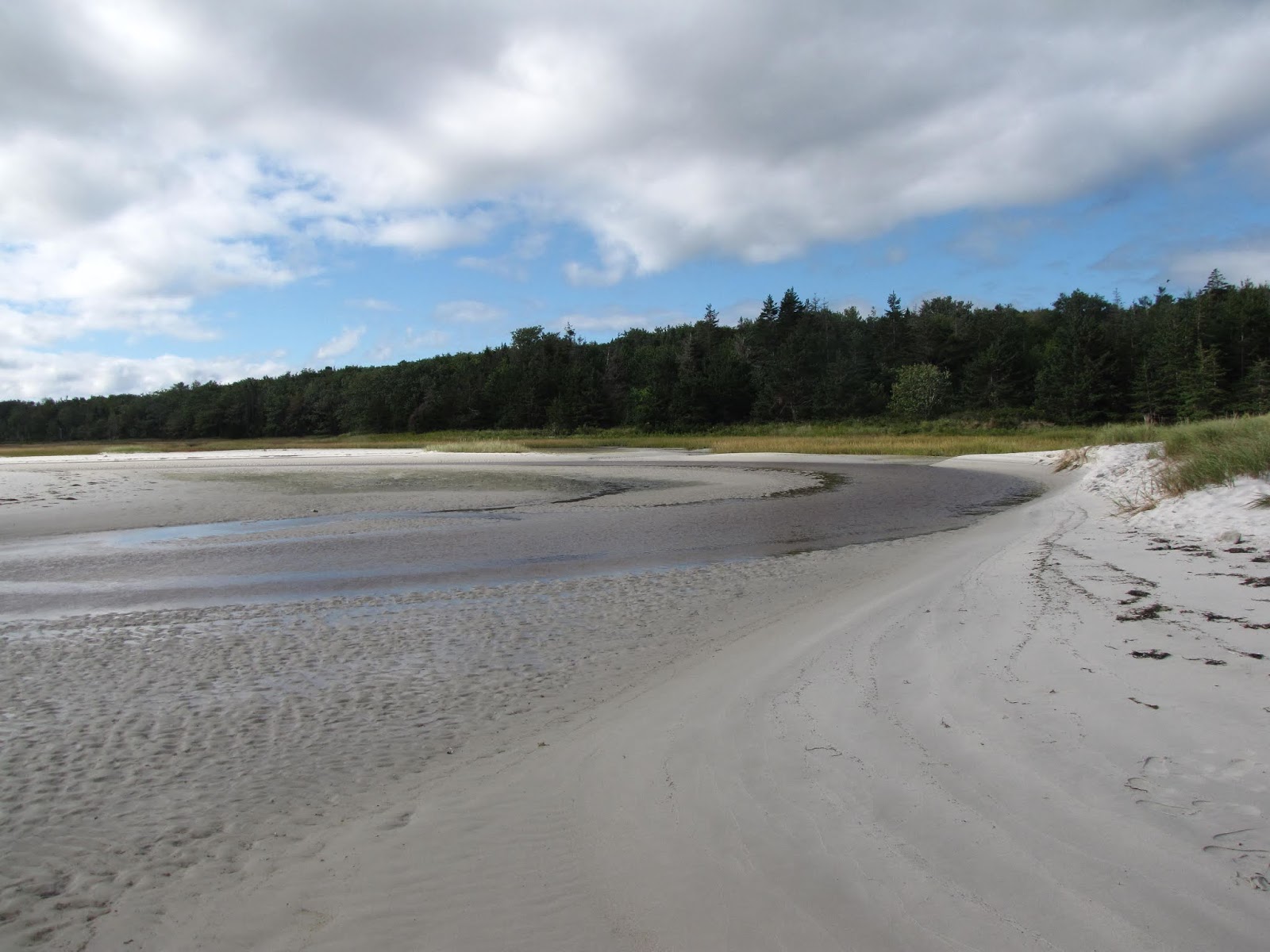
Acres of pale sand.


A stream makes its way down to the sea.


A flock of Sanderlings displaying typical feeding behaviour. They run down the beach as a wave recedes, picking up morsels dropped on the sand, and then scamper back up the beach as the next wave chases them.


Some nice asters growing just beyond the high tide line.

Lunenburg.
We were recommended to take the slower, but more scenic coast road and the LaHave ferry. The route was indeed scenic, but the ferry was out of commission for a week so we had to keep on driving.


As we drove to Lunenburg we spotted this sign. A shortcut home?

This port town is well known for its colourful buildings.  Many of them feature the famous “Lunenburg bump”, a large dormer popular in the late 19thcentury.

A particularly nice example of the Lunenburg bump.


And some nice boats.


We'll have 2 Kalaharis and an Atacama.


An eye-catching spraxia.

Peggys Cove.
Yes, there should be an apostrophe. Write to the council about it. (We didn't.)

Tourists are urged to admire and photograph lighthouses all along the Atlantic coast. There's something about the one at Peggys Cove that particularly pleases the eye. We concede that this one is worth the time. Maybe it's the bare, almost-white rocks it's perched on.


The classic shot.


While we were there the sky was competing with the lighthouse for our attention.

We found space in a car park to stay the night. We got into conversation with a Ukranian-Canadian who was preparing to sleep in his car, and Ievgen stayed for dinner; the first time we had hosted a guest for a meal in Gregory.

The next morning we set off for the ferry to Prince Edward Island.


The lakes near Peggys Cove were 'steaming' attractively as we drove by.